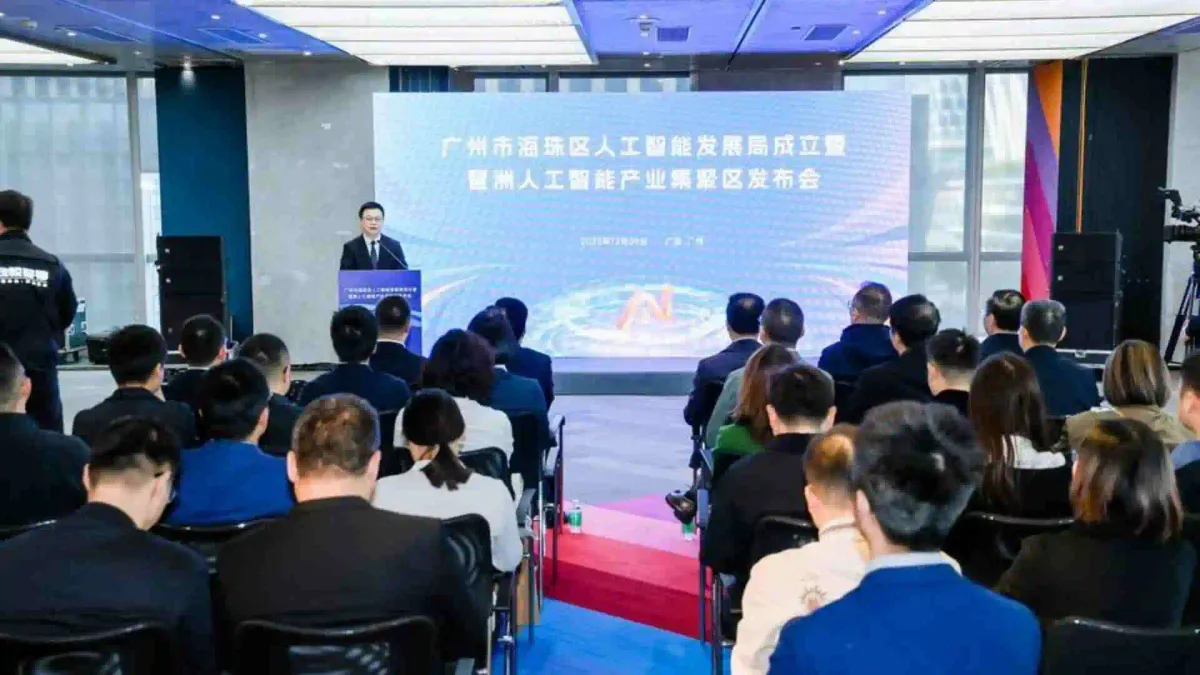
On December 28, 2025, authorities in Haizhu District of Guangzhou, capital of Guangdong Province, launched an AI development bureau tasked with unifying fragmented management, consolidating technical resources, and promoting coordinated industrial development within the district.
Officials said the bureau will focus on aligning cutting-edge artificial intelligence research, business support and application scenarios, as well as attracting and nurturing companies that master key technologies in areas such as intelligent vehicles and industry-specific AI solutions.
Local representative Yu Lihui said placing dedicated personnel in a central office structure should improve planning and execution of AI development policies.
Haizhu District And AI Growth
Haizhu has laid groundwork for AI industry acceleration in recent years. The district is home to the Pazhou AI industry cluster, one of three key clusters planned by the Guangdong provincial government, and supports nearly 8,000 AI-related companies working on advanced models and applications spanning next-generation IT services.
Prominent local efforts include ZJTECH’s work on AI-enabled textile sector automation, which compresses complex selection and design tasks into rapid AI-assisted workflows, and South China Brain-Computer Interface Technology Co.’s development of an AI-controlled input device that allows paralyzed users to interact with digital interfaces.
At the bureau’s inauguration, plans were announced for the Pazhou Space Intelligent Computing Center, whose first phase will build a 100-petaflop-scale computing cluster that officials say will support enterprise innovation and research across AI domains.
Local leaders emphasized that integrated computing infrastructure and scenario-based AI applications are foundational to building industrial ecosystems capable of supporting diversified intelligent solutions, from fashion supply chains to autonomous systems in transport and services.
Other Chinese Cities Establish Similar Offices
Guangzhou’s move reflects a broader pattern of municipal and regional governments establishing dedicated AI governance bodies. In September 2025, Wenzhou City in Zhejiang Province launched its own AI development bureau to coordinate citywide computing power, data services and algorithm infrastructure planning.
More recently, the city of Zhuhai in Guangdong inaugurated a bureau focused on expanding smart-city applications and ecosystem partnerships with AI firms.
Industry observers say these structural changes at local government level aim to align policy, capital and technical resources more closely as China pursues national objectives for AI integration across economic sectors through the “AI Plus” initiative outlined by the State Council. That policy framework sets goals for broad AI adoption in key industries by 2027 and near-ubiquitous use of intelligent terminals by 2030.
Final Takeaway
Dedicated bureaus signal that local authorities see coordination and ecosystem planning as central to competitive positioning in China’s intelligent economy. By organizing functions such as industrial coordination, resource allocation and scenario innovation under one office, regional governments hope to accelerate application-oriented AI development and support enterprise ecosystems that can drive sustained growth and technological advancement.