Stride, a startup registered in Norwich, England, that sells home tests of deoxyribonucleic acid (DNA), blood and gut health through a membership, has closed a £4.6M (about $6M) seed round, its first external funding. The company did not name a lead investor. Its backers include Arāya Ventures, an early-stage fund with offices in London and Dubai, and Morgan Stanley Inclusive & Sustainable Ventures, the bank’s in-house accelerator.
The venture firm Better Ventures also took part, along with Innovate UK, the United Kingdom (UK) government’s innovation agency, an investor from the Andreessen Horowitz (a16z) Scout Fund and a group of angels. Stride says part of the money will pay for a United States (US) launch of StrideOne, its membership. The rest goes on a wider product range and a biological age test, still in development, that draws on several types of data.
Members collect samples at home and post them off, then receive reports on their genes, gut bacteria and blood markers, with a dietetics or physiology expert on hand to help them act on the results. Andrew Steele, Stride’s co-founder and chief executive, said the model borrows from elite sport.
“Elite athletes have long understood the value of testing, tracking and continually adapting,” he said. “But that approach shouldn’t be reserved for people competing at the highest level.”
What A StrideOne Membership Includes
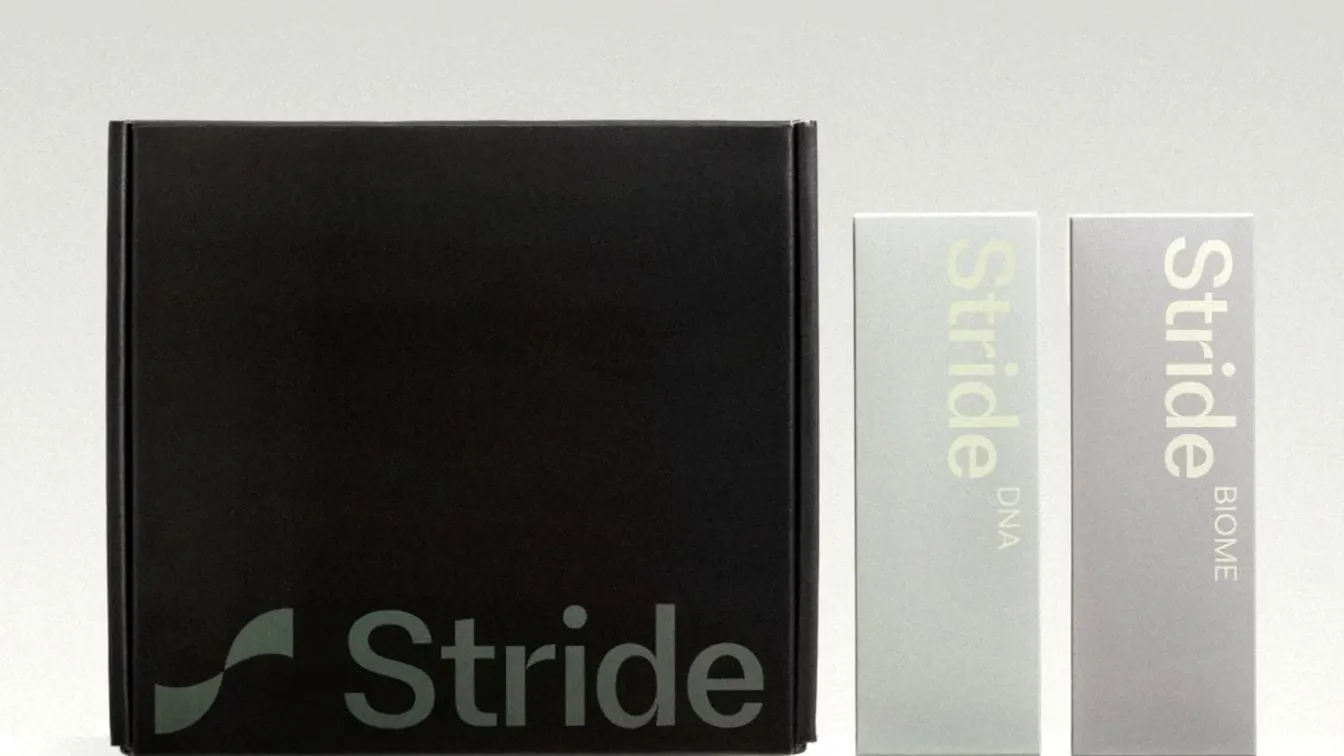
StrideOne bundles three kits: one for DNA, one for the gut microbiome and one for blood. Stride’s website lists 164 genetic variants, 406 microbiome markers and 74 blood biomarkers. Members also get four one-to-one video calls a year with a dietetics or physiology expert, plus support between calls, and a gut and blood retest partway through the year.
Each member receives a biological age score, which Stride calls StrideAge. The company says it is based on nine blood biomarkers and updated at every retest. Biological age is an estimate of how the body is ageing, and it can differ from a person’s age in years. Members also get 25% off Stride’s own supplements.
When StrideOne launched in the UK in September 2025, Stride priced it from £699 a year. The launch material described downloadable reports that members can share with their own healthcare providers.
Stride’s website describes its DNA, methylation and microbiome tests as “educational tools” that are “not diagnostic”, and it sells its supplements as food supplements. Methylation refers to chemical tags on DNA that affect how genes are switched on and off. The blood test is sold in the UK only.
The company says it has more than 16,000 customers and that it retained 85% of StrideOne members over the first 13 months. Both figures are Stride’s own. It has also signed testing partnerships with Triple Bond, a club at The BoTree hotel in London, and LongLane, an alcohol-free wellness destination, which use its tests to personalise what their members receive.
From Beijing Track To DNA Testing
Steele ran the 400m for Great Britain and was part of the men’s 4x400m relay team at the Beijing 2008 Olympics. The quartet first finished fourth, then moved up to bronze after retests of stored samples showed Russia’s anchor runner, Denis Alekseyev, had used a banned substance. Team GB arranged for the quartet to receive the medals at the London Stadium in 2017.
After athletics, Steele co-founded DNAfit, a personal genetics company. Prenetics, a genetic and diagnostic testing group, bought DNAfit in 2018 and later listed on the Nasdaq stock exchange in 2022.
A November 2024 release announcing Stride’s UK launch set out a broader early offer: home blood, gut and DNA tests, personalised supplements, prescription treatments from its digital pharmacy and a care team that included doctors, pharmacists and dietitians. Steele linked that mix to what is “being called Medicine 3.0”, which joins preventative wellness with clinical care. The current membership puts the test kits and expert calls at the centre.
Where The Seed Money Is Going
Stride has not given a date for the US launch, but says it plans to offer StrideOne outside the UK before the end of 2026. For now, its global website, priced in US dollars, sells single kits and invites visitors to join a waitlist for StrideOne.
Innovate UK has also funded two of Stride’s research projects. One is a multiomic method for measuring biological age, which combines several layers of biological data rather than a single test. The other is an artificial intelligence (AI) health copilot designed to bring together lab results, wearable data and health records.
Steele expects active health monitoring to have an impact on preventing disease “much bigger even than eradicating all cancer”. Stride is betting that members who keep getting useful insights will keep paying for the membership year after year.
Rupa Popat, founder and managing partner at Arāya Ventures, said Stride sits where prevention, personalisation and the consumerisation of health meet. Her firm closed a $26.3M debut fund in July 2025 to back pre-seed and seed startups in health, financial technology, commerce and the future of work. Morgan Stanley’s programme pairs equity investment with a five-month accelerator.
A Policy Push Toward Prevention
The UK government’s 10 Year Health Plan for England, published in July 2025, sets out three shifts for the National Health Service (NHS). One is a move from sickness to prevention. The other two move care from hospitals into communities and from analogue to digital.
Stride sits outside that system, selling directly to consumers who pay for their own tests. Steele said in comments released with the funding that preventative health “can sometimes sound boring or worthy”, and Stride has placed its tests inside wellness clubs and hotels as well as selling them directly.
Bigger Rivals With Bigger Cheques
Neko Health, the Swedish body-scan company, raised $700M in a Series C in July 2026 to enter the US for the first time. Lightspeed Venture Partners and O.G. Venture Partners co-led the round. Neko’s 60-minute scan combines sensors with blood analysis, followed by a consultation with a doctor.
In the US, Function Health took $450M in growth financing from General Catalyst’s Customer Value Fund in July 2026. Its membership offers more than 160 lab tests, and the company also offers magnetic resonance imaging (MRI) and computed tomography (CT) scans.
Stride’s £4.6M is a far smaller first cheque, and its offer is built differently: kits by post rather than clinic scans, with dietetics and physiology experts handling the follow-up calls. A US launch would put it in Function’s home market.
Steele puts the pitch more simply: “Health shouldn’t be harder than an Olympic training block.” His funding post sets out the longer aim, which is to make preventative health as common as the iPhone.