

Venture firm Vsquared has led a €9.1M round in Quint Computing, a German startup building a quantum chip that blocks many errors in hardware before software has to correct them. Quantonation, Nucleus Capital, Faber, Vanagon Ventures and ZOHO.VC also invested, alongside industry figures such as Mikko Möttönen, who co-founded Finnish quantum computer maker IQM and QMill.
Quint began at Friedrich-Alexander-Universität Erlangen-Nürnberg (FAU), and the university calls the round the largest seed investment yet in a German quantum computing company.
Quint has also won a separate €2.2M Pathfinder grant from the European Innovation Council, the EU body that funds breakthrough deep-tech research and startups. The funds will pay for a larger research and engineering team, further development of the processor and the company’s first projects with industrial users. New hires will cover chip design, fabrication, error correction and applications, adding to a team of about ten people.
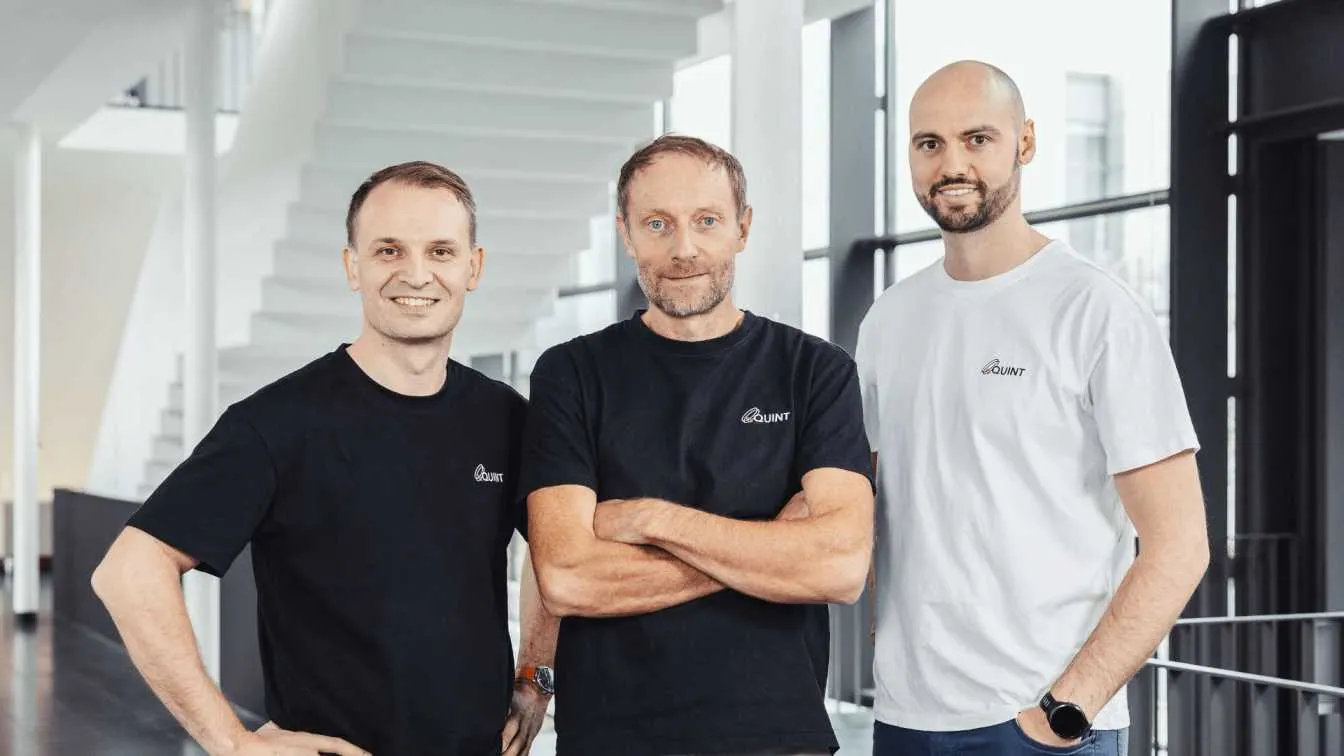
Physicists Christopher Eichler and Michael Hartmann founded Quint in October 2025 with economist Jona Stinner. Chief executive Eichler has held FAU’s Chair of Experimental Physics since 2022, while chief technology officer Hartmann has led its Chair for Theoretical Physics II since 2019 and previously worked on Google’s quantum team. Stinner runs finance and operations. “The race to build commercially viable quantum computers is gaining momentum,” Eichler said.
Stopping Errors In Hardware
A quantum computer stores information in qubits, units far more fragile than the bits in an ordinary computer. Heat, stray signals and imperfect control can flip a qubit’s value or scramble the balance between its states, and physicists call these errors bit-flips and phase-flips. Most error-correction schemes spread one reliable “logical” qubit across many physical qubits, so machines grow much larger and harder to build.
Quint builds its chip from superconducting circuits, which carry electricity without resistance when cooled close to absolute zero. Its patented design suppresses most errors in the hardware and leaves correction algorithms to handle the rest. The company says each correction cycle takes less than a microsecond, and that the fully implemented architecture could cut system complexity, hardware requirements and energy use by a factor of 100 while keeping computing speeds high.
The startup is aiming its machines at pharmaceuticals, chemicals, logistics and manufacturing. Partners named on Quint’s website include the Max Planck Institute for the Science of Light, the Fraunhofer Institute for Electronic Microsystems and Solid State Technologies, the Leibniz Supercomputing Centre, engineering software maker Ansys and DB Systel, the IT unit of Deutsche Bahn.
Research Base And Rivals
Quint builds on years of quantum research at FAU. In 2022 Eichler served as spokesperson for an 11-member FAU group that received roughly €3M from the Bavarian state to study how to measure and control qubits, with work on superconducting quantum computers and error correction. The money came through Munich Quantum Valley, the regional programme whose network Quint is now part of.
Big technology groups are tackling the same problem. In December 2024 Google said the error rate on its 105-qubit Willow chip roughly halved each time engineers enlarged the grid of physical qubits encoding one logical qubit, a result the company presented as a long-standing goal of the field.
Other European quantum startups have also drawn investment in recent weeks. Oxford spinout QuantrolOx raised €12M in October for software that tunes qubits automatically, and Aalto University spinout Coherence Quantum secured €2.78M for components that filter noise from quantum computer control lines.
Quint aims to handle most quantum errors inside the chip rather than through extra qubits alone. The year-old company now has venture backing and an EU grant as it plans the move from university research towards its first industrial projects.