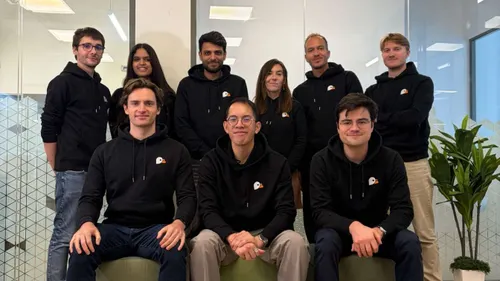


QuantrolOx has raised €12M in a Series A round led by London investor IW Capital. The University of Oxford spinout, now headquartered in Espoo, a technology city next to Helsinki in Finland, makes software that takes over a job physicists usually do by hand: getting a quantum computer’s qubits ready to work.
IW Capital is an early-stage investor that backs fast-growing British technology businesses.
“QuantrolOx has automated the slowest, most expert-dependent part of running a quantum computer, on any hardware,” said Charlie Lyon Carroll, an investment director at the firm.
That slow, expert part is calibration. Qubits, the basic units a quantum computer calculates with, are easily thrown off by heat, stray signals and tiny flaws in the chip, and no two behave quite alike. Before a machine can run anything, engineers must find the exact pulses and voltages that control each qubit, then check them again as conditions drift.
Co-founder and chief executive Vishal Chatrath has described the frustration plainly:
“No physicists want to waste time tuning qubits, they want to use them.” He says QuantrolOx is “building the foundations of the quantum industry”, with tools that “industrialise quantum hardware and train the people to run it”.
The European Innovation Council (EIC) Fund, the European Union’s equity fund for deep-tech startups, joined the round along with Transpose Capital. Earlier backers Hoxton Ventures and Hermann Hauser, co-founder of the British computer maker Acorn, also took part. QuantrolOx will spend the money on developing and rolling out its software and on growing in North America.
How The Tuning Software Works
The software at the centre of that plan is Quantum EDGE, which automates the tuning and testing of superconducting quantum computers. These machines build their qubits from tiny electrical circuits chilled close to absolute zero inside a large refrigerator. QuantrolOx claims on its website that the software makes bringing up and tuning qubits “more than 100x faster”, cutting some basic experiments to seconds.
Engineers use Quantum EDGE through a web browser, while a component in the lab links directly to the control electronics, the instruments that send signals to each qubit. QuantrolOx says it supports gear from Qblox, Quantum Machines and Zurich Instruments, and that users can write their own automations in a few lines of the Python programming language.
Those automations work at the level of the machine itself. Higher up, other startups build tools that turn ordinary Python into programs a quantum computer can run, while others make hardware that cleans up control signals on their way into the refrigerator. QuantrolOx’s job is to get each qubit ready to run those programs.
Chatrath’s point about training people runs through Quantum EDGE Academy, an online course platform where students practise on a simulated superconducting qubit before they touch real hardware. Its first course walks learners through finding a qubit and measuring its basic properties, with more courses listed as coming soon.
Berkeley And Bengaluru Expansion
That growth starts in California, where QuantrolOx opened an office in Berkeley in September, after signing a five-year memorandum of understanding earlier this year with the University of California, Berkeley’s Roger Herst Quantum Nexus. The deal builds on the company’s research with Professor Irfan Siddiqi’s Quantum Nanoelectronics Laboratory.
QuantrolOx says it also works with hardware developers and research groups in the United Kingdom, the European Union, Taiwan and India. In India, its open-architecture system, VIDYAQAR, was chosen to lead the development of a quantum hub at the Manipal Institute of Technology in Bengaluru, the southern city at the centre of India’s tech industry.
That hub opened in October around a Bluefors refrigerator built to hold up to 25 qubits. Swedish firm ConScience supplies the superconducting chip, Dutch firm Qblox the control electronics and QuantrolOx the Quantum EDGE software, and the hub aims to train 100 quantum engineers by December.
In June, QuantrolOx also teamed up with AQSolotl, a Singapore quantum control company spun out of Nanyang Technological University and the National University of Singapore. The pair plan to combine Quantum EDGE with AQSolotl’s Chronos-Q control system to cut manual calibration. Beyond Espoo, Oxford and Berkeley, QuantrolOx has offices in Bengaluru and Delft, a university city in the Netherlands.
Oxford Research Behind The Startup
QuantrolOx was founded in 2021 by Chatrath, a former head of automotive at Nokia who went on to co-found the artificial intelligence (AI) company Secondmind, along with three Oxford researchers. Andrew Briggs is emeritus professor of nanomaterials at the university, and Natalia Ares is an associate professor of engineering science who uses AI to explore the limits of quantum technologies.
The fourth co-founder, Dominic Lennon, did his doctorate at Oxford and is now chief product officer. All three researchers were authors of a 2020 study in which an algorithm tuned quantum devices into a working state with no human help, in a median time of under 70 minutes.
The devices in that study were quantum dots, tiny spots on a semiconductor chip that trap single electrons, rather than superconducting circuits. The paper put the time experienced physicists need to tune a comparable device by hand at roughly three hours.
The study predates QuantrolOx, which was founded the following year. The startup later raised a £1.4M seed round led by Nielsen Ventures and Hoxton Ventures, then a second €3.5M seed round led by Finnish investor Voima Ventures. Around that second round, it moved its headquarters to Finland, keeping Oxford as its main base for applied research.
Ready For The Next Stage
QuantrolOx goes into its next stage with fresh money from IW Capital and its earlier backers, a new office in California and its software running at a training hub in India.
Its case rests on taking routine qubit tuning off physicists’ hands, so quantum machines spend more time doing useful work. The speed claims come from the company and its founders’ research, which used a different kind of device from the superconducting machines Quantum EDGE is built for.