

Paris startup Qluster has secured €4.7M in a pre-seed round, its first outside funding, to build a quantum computer that processes information using light. Quantonation, a venture fund that invests in quantum and physics-based technology, led the round.
Quantum Launchpad, a French startup studio for quantum technology, and Bpifrance, France’s public investment bank, also took part. Quantum Launchpad and Paris incubator Agoranov have supported Qluster since it was founded a few months ago.
Qluster will use the money to set up its own research lab to improve its technology. It also plans to hire experimental physicists and specialists in quantum computing theory and design.
Computing With Light
Many quantum computers today use superconducting circuits, which must be chilled to near absolute zero, or atoms and ions held in vacuum chambers and controlled by lasers. Qluster instead works with photonics, using particles of light to carry quantum information.
Rather than storing information in single particles of light, Qluster encodes it in properties of a light beam that can take any value in a range, an approach known as continuous-variable photonic computing. The system generates linked, or entangled, groups of light states, called clusters, which act as the raw material for calculations.
Qluster aims for designs that can handle large numbers of these light modes at room temperature, which it says could make the machines easier to scale up and keep stable.
Qluster is a spin-off of Laboratoire Kastler Brossel, a Paris physics lab linked to three Nobel Prizes. It builds on a miniature light source that Valentina Parigi and David Fainsin developed and patented there. Qluster says the principle behind the source has been tested in experiments and published in a scientific journal.
Designing Backwards From The Problem
Qluster starts with the calculations that companies actually need, turns them into quantum circuits and works out what they would demand in qubits, processing steps, speed and energy. Only then does it design the machine, a method it calls “Architecture First”.
“For several years, the race to build quantum computers has largely focused on developing increasingly powerful qubits,” said Fainsin, Qluster’s co-founder and chief executive. He said the challenge now is making sure the computer’s design meets industry’s needs.
Ylan Tran, an investor at Quantonation, said: “Scalability is currently the central challenge in quantum computing.”
Qluster aims to build an intermediate-scale machine able to tackle its first industrial problems by 2032. By 2036, it hopes to have a large, error-corrected, general-purpose quantum computer that would need thousands of logical qubits, the reliable units formed by combining many physical ones.
A Four-Person Founding Team
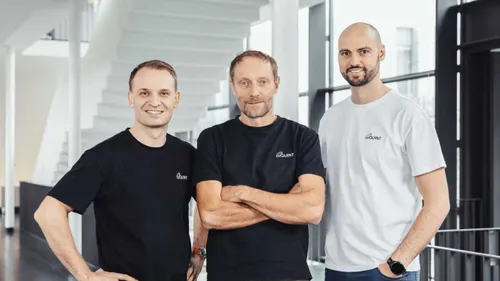
Fainsin and chief technology officer Ambroise Boyer both hold doctorates in quantum optics. Chief operating officer Clarisse Thibault previously worked at CNRS Innovation, the technology transfer arm of France’s national research agency. Parigi, a physicist and professor at Sorbonne University, is chief scientific officer and chairs the scientific advisory board.
Qluster won the 2026 Grand Prize of i-Lab, a French government innovation competition supported by the France 2030 investment plan.
Earlier this month, German startup Quint Computing closed €9.1M to reduce errors in quantum chips.
Qluster now has early funding and a light source whose principle has been tested in the lab, but a working machine is several years away. It says designing around real industrial calculations, rather than raw qubit counts, is how it plans to reach its 2032 and 2036 goals.