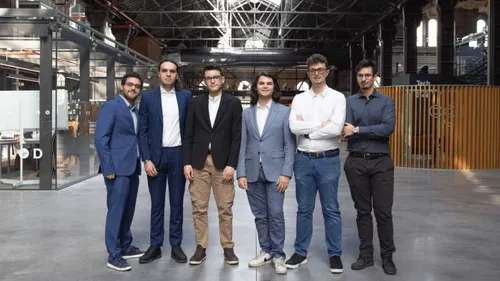

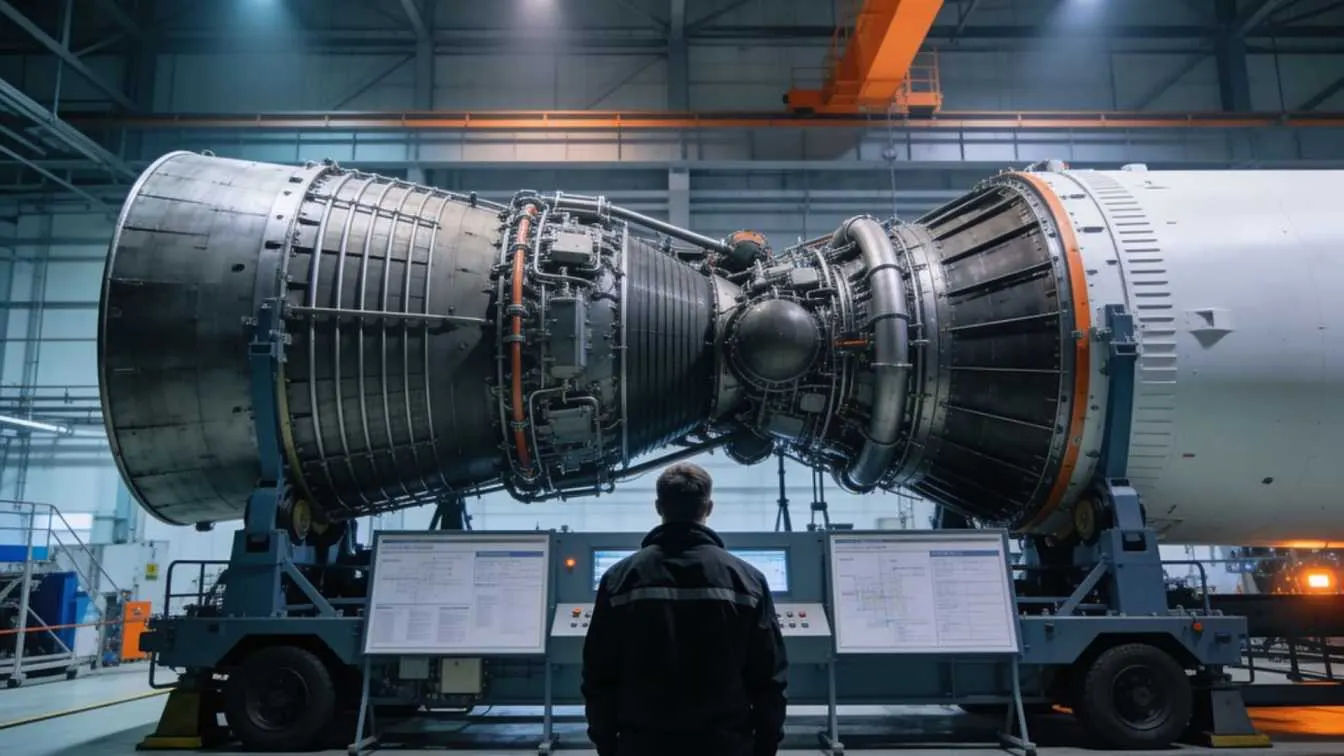
MuRay, a startup based in Hamburg, Germany, has raised €7.1M to look inside metal parts that X-rays cannot get through. Its scanners use beams of muons, tiny particles that pass through dense material. The first targets are 3D-printed rocket engines and gas turbine components, where defects can hide deep inside the metal.
The money comes in two parts: €3.5M from private investors and €3.6M in public funding, including a grant from Horizon Europe, the European Union’s research programme. First Momentum Ventures led the private round, with Caelora as co-lead.
Caelora, a Munich laser company spun out of fusion energy developer Marvel Fusion this year, also works with MuRay on laser technology. Superangel, Mätch VC, Arcas VC and Tiny VC joined the round, along with existing investor Nordic Science Investments.
Muons, MuRay says, can pass through more than a metre of steel and other dense metals. “X-rays reach their limit at a few centimetres of steel,” said Andi Hektor, MuRay’s co-founder and co-chief executive.
A Muon Beam Made On Demand
A muon is an elementary particle similar to an electron but about 200 times heavier. Muons rain down on Earth all the time from cosmic rays, and scientists have used them to see inside volcanoes and ancient pyramids. The natural flow is thin, though, so this kind of passive scanning can take days.
MuRay makes its own muons instead, with a compact laser-plasma accelerator that produces a controlled beam on demand. The machine fires powerful lasers into a plasma, a hot, electrically charged gas, to speed up particles over a short distance. The company’s detectors and artificial intelligence (AI) software then turn the muons that pass through a part into a 3D image of its interior.
According to MuRay, a full scan takes minutes rather than hours, reaches sub-millimetre detail in metal, ceramic and composite parts, and can tell apart materials that look the same on an X-ray. The company also says the method uses a much lower radiation dose than X-rays.
“Defects that manufacturers can’t see keep parts out of service for longer than they should be,” said Kristjan Põder, MuRay’s other co-founder and co-chief executive.
Põder led work on laser-plasma accelerators for industrial and medical uses at DESY (Deutsches Elektronen-Synchrotron), Germany’s particle physics research centre in Hamburg.
“We grew out of the laser-plasma accelerator community at DESY,” he said. Hektor previously co-founded GScan, an Estonian company that scans large structures and cargo using natural muons.
MuRay launched in 2025 and first announced itself that November, along with an early funding round led by Nordic Science Investments. The company has a branch in Tallinn, Estonia, is hiring seven physicists and engineers in Hamburg and expects to grow to about 25 people by the end of 2027.
Rocket Engines Come First
MuRay is starting with quality checks on safety-critical parts and has modelled a rocket engine inspection with the German Space Agency at DLR (Deutsches Zentrum für Luft- und Raumfahrt), Germany’s aerospace research centre. The first test on a real engine is planned for 2027.
According to Põder, MuRay has a joint project with Siemens Energy, funded by IFB Hamburg (Hamburgische Investitions- und Förderbank), the city’s investment and development bank. He also counts Airbus and other aerospace companies as potential customers, although MuRay has not named any customers yet.
Also in 2027, MuRay plans to launch its first industrial imaging service, pairing its own system with the existing electron beam at DESY. The first full-scale system with its own laser-driven accelerator is due in 2029. MuRay is also developing a mobile version about the size of a shipping container, so parts can be inspected on site.
“This funding will help us continue proving the physics whilst delivering our first service to industrial customers,” Põder said.
Beyond manufacturing, MuRay is in talks with international ports about spotting nuclear material, such as uranium, hidden in dense cargo. Further out, the company sees uses in monitoring radioactive waste, inspecting infrastructure, and medical imaging.
The Road To 2029
MuRay has gone from a research idea at DESY to a funded company in little more than a year, backed by private investors, a Horizon Europe grant and laser partner Caelora.
An imaging service at DESY and the first real rocket engine test with DLR are planned for 2027, followed by a full system with its own laser-driven accelerator in 2029. Rocket engines and turbine parts lead the way, with cargo scanning and other uses further out.
The 2027 tests will show whether the method works on real hardware, and whether manufacturers could check thick metal parts from the inside before they go into service.