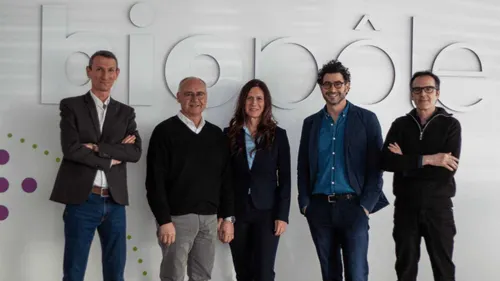


Czech medical technology startup Kardi Ai has secured €5.3M to expand a service that tracks a person’s heart rhythm for weeks at a time. The money comes in a Series A round, usually a startup’s first large venture round after its early seed funding. Munich-based health investor Callisto Health led the round.
Two banks from the Erste group, Czech lender Česká spořitelna and Slovak lender Slovenská sporiteľňa, joined through Seed Starter, their investment arms for young companies. Earlier backers BrightCap Ventures, Purple Ventures, DEPO Ventures and Garage Angels also invested.
The company plans to use the money to enter new markets in Europe and Asia, with Germany first in line. It also plans to develop AI models that aim to estimate a person’s risk of a heart rhythm problem before one occurs.
How The Monitoring Works
Kardi Ai’s service uses a fitness-style chest strap fitted with an electrocardiogram (ECG) sensor, which records the heart’s electrical activity. The strap sends readings to a mobile app, and AI software analyses the recordings for arrhythmias, or irregular heart rhythms.
Patients wear the strap at home for weeks. The company says each report is ready about five minutes after a measurement ends and is written so both the patient and their doctor can follow it.
That approach differs from a standard Holter monitor, a portable ECG that patients usually wear for a day or two. Rhythm problems can come and go, so a short recording may miss them.
Tomáš Skála, a cardiologist, co-founded Kardi Ai and is its chief science officer. “Arrhythmias appear randomly and if you don’t catch them at the right time, it’s like they never existed,” he said in 2025.
Kardi Ai says the service does not make a diagnosis and instead gives doctors monitoring data to support their decisions. The service is certified as a Class IIa medical device, the second of four risk classes, under the European Union’s Medical Device Regulation (MDR), the bloc’s rules for medical products.
Kardi Ai says monitoring costs about 14 Czech crowns a day without help from an insurer. In February 2026, it agreed to work with two Czech health insurers, one run for the Ministry of the Interior and one for employees of carmaker Škoda.
At the time, the company said it was still negotiating to join the national reimbursement system, through which public health insurers pay for approved care. Chief executive Vlastimil Hrabal said that if insurers covered even part of the cost, many more people would be able to afford the service.
Early Use In The Czech Republic
Kardi Ai says more than 6,000 people in the Czech Republic have used the service so far. It works with more than 70 hospitals and more than 20 companies, some of which offer it to staff as a workplace benefit. Partners include the EUC chain of clinics and the Benu pharmacy group.
According to company figures, the service flagged a possible arrhythmia in about a quarter of users and classed more than 500 of those findings as critical. In 2025, the company said it was preparing a clinical trial with university hospitals in Olomouc, where it is based, and Ostrava, in the north-east of the country.
Among the rhythm problems such monitoring looks for, the most common is atrial fibrillation, an irregular and often fast heartbeat that starts in the heart’s upper chambers. The European Society of Cardiology has estimated that one in three Europeans will develop it, and that it raises the risk of stroke fivefold.
Longer monitoring tends to find more cases. The CRYSTAL AF trial, published in the New England Journal of Medicine in 2014, followed patients whose stroke had no identified cause. Implanted heart monitors detected atrial fibrillation in 12.4% of them within a year, against 2.0% among patients given routine follow-up. The trial used devices placed under the skin rather than chest straps, so its results do not translate directly to Kardi Ai’s service.
From Olomouc To New Markets
Kardi Ai was founded in 2022 and is based in Olomouc, a university city in the east of the Czech Republic. Before the Series A, it closed a €1.5M seed round, its first outside funding, in November 2023 and added €1.1M in April 2025.
When it raised the 2025 round, Hrabal said the aim was “to become the European leader in continuous heart monitoring”.
The company entered Slovakia, its first market abroad, several months ago and works there with more than 20 doctors, mainly cardiologists. It also operates in Poland, Romania and Bulgaria.
Romania and Bulgaria have some of the highest death rates from heart and circulatory disease in Europe. In Romania, Kardi Ai has piloted the service in selected hospitals, and healthcare group Medicover has moved towards using it more widely. In Bulgaria, the company works with BGO Software, which builds hospital IT systems.
Germany, where Kardi Ai has run pilot projects, is the next market. Further afield, the company has secured regulatory approval in India and the United Arab Emirates. It has also applied for medical device approval in Singapore.
“Nearly two billion people live in the markets where we already operate or are preparing to launch,” Hrabal said.
Other startups are applying wearable monitoring elsewhere in care. Swiss startup CHD is developing a washable belt for monitoring pregnancies.
Predicting Risk Before It Shows
Alongside new markets, Kardi Ai is building models that combine several ECG measurements to estimate a person’s risk of an arrhythmia.
“We are gradually moving beyond detecting heart rhythm disorders towards technology capable of identifying an increased risk before arrhythmia manifests,” Hrabal said.
The predictive models are still in development. They will need to pass clinical studies and gain regulatory approval before doctors can use them.
“The new capital will allow us to validate this technology at global scale and across patient demographics,” he added.
Kardi Ai closes its Series A with a certified product, thousands of Czech users and approvals in India and the United Arab Emirates. The company plans to spend the money on reaching more countries and on turning its monitoring data into risk prediction, a step that has yet to pass clinical testing.