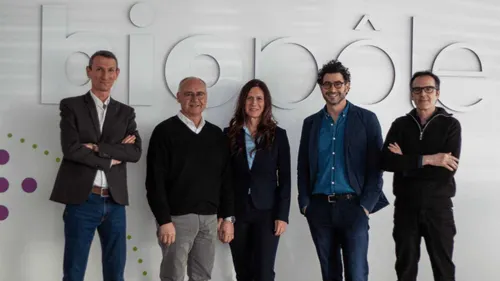


ALLOX, a biotech company spun out of a Barcelona genomics institute, has closed a $10.5M (€9.4M) seed round to find places on disease-causing proteins where a drug can attach and change how the protein behaves. The company says many of its targets are proteins that conventional medicines have struggled to reach.
Asabys, a Barcelona healthcare investor, led the round through its Sabadell Asabys II fund, and had already made the earlier pre-seed investment that set up ALLOX’s first team and facilities. Clara Campàs, the firm’s co-founder and managing partner, said: “We believe ALLOX is uniquely positioned to expand the scope of druggable biology.”
Spain’s innovation agency, the Centre for Technological Development and Innovation (CDTI), joined through its venture capital vehicle Innvierte. The Institut Català de Finances, the Catalan government’s public financial institution, also took part.
ALLOX will use the money to scale its platform, build its own artificial intelligence (AI) models and grow its in-house drug discovery team, and the funding will also support research collaborations with pharmaceutical and biotech partners. “This financing marks an important milestone, enabling us to advance our internal drug discovery pipeline,” said Júlia Domingo, the company’s co-founder and chief executive.
Where Drugs Can Grip A Protein
Proteins do most of the work inside a cell, and many diseases start when one of them misbehaves. Most drugs work by blocking a protein’s active site, the part where it does its main job, but some proteins offer no suitable pocket there, and some diseases become resistant once a drug is in use.
ALLOX instead looks for spots away from the active site where a small molecule, the kind of compound found in most pills, can bind and turn the protein’s activity up or down. Scientists call these allosteric sites. To find them, the company changes a protein’s building blocks, its amino acids, one at a time and measures the effect of thousands of these changes in parallel. Genetic sequencing reads out the results, and computer models turn them into a map of the regions that control how the protein folds and interacts with others.
The experiments also reveal the protein’s main binding sites and new pockets where a drug might fit. ALLOX is aiming first at targets that have been hard to drug, including points where two proteins lock together inside cells, and transcription factors, the proteins that switch genes on and off.
The company’s work currently centres on cancer, immune and inflammatory diseases. Its lead programme, ALX-001, is a drug candidate designed to block one specific target through an allosteric site, and is in preclinical development, the stage before testing in people. ALLOX has not disclosed which protein that is.
Born In A Barcelona Genomics Lab
The method was developed in the laboratory of Ben Lehner at the Centre for Genomic Regulation (CRG) in Barcelona, where Domingo did her doctorate. Work from the same lab includes a 2023 study in Nature that measured more than 26,000 altered versions of KRAS, a protein linked to about one in ten human cancers, and turned up many more strong allosteric sites than the researchers expected.
Lehner, Domingo, André Faure and Pablo Baeza founded ALLOX as a CRG spin-out, and the company began operating early in 2024. Lehner now also heads the generative and synthetic genomics programme at the Wellcome Sanger Institute in the United Kingdom. ALLOX has 15 staff and works from a laboratory at the Barcelona Science Park.
A Chair With Deal Experience
Alongside the round, ALLOX has appointed Morten Graugaard as independent chair of its board. Graugaard argues the platform goes beyond finding molecules that merely stick to a protein. He said, “ALLOX fills a critical data gap, enabling the development of functional molecules rather than simply identifying binders.”
Graugaard has more than 20 years in life sciences investing and deal-making. He is chief business officer at Orbis Medicines, a company developing pill alternatives to injected biologic drugs, and was previously a partner at Novo Holdings.
He led the $658M purchase of Chelsea Therapeutics while at the Danish drugmaker Lundbeck. He has also held chair, board and advisory roles at several biotech companies, including Syndesi Therapeutics, which AbbVie bought in 2022 for up to $1B.
Turning Maps Into Medicines
ALLOX began as a method for mapping proteins in a Barcelona research lab, and this round moves the company towards medicines of its own. ALX-001 is the first of them, while planned collaborations with drugmakers would put the same maps to work on partners’ targets.
The platform rests on the idea that a protein with no usable active site may still be controlled from somewhere else on its surface. With fresh funding and a chair experienced in biotech deals, ALLOX is now set to test how far that idea carries beyond the laboratory.