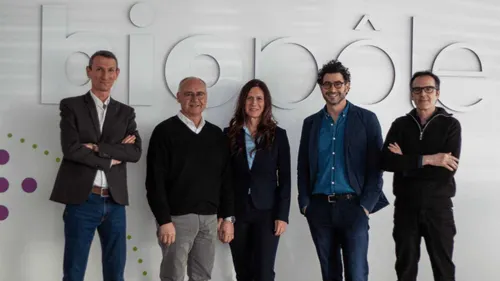


University of Leeds spinout Adsilico has raised £10M to expand its work testing medical implants on patients who exist only inside a computer. PXN Ventures, a venture capital firm that invests across the North of England, Scotland and Northern Ireland, led the Series A round.
The company is based at the university’s Nexus innovation hub in Leeds, a city in the north of England. It uses artificial intelligence (AI) to build models of hearts and blood vessels from anonymised hospital scans, so that manufacturers can simulate how a valve or stent behaves in people of different ages, sexes, ethnicities, body sizes and medical conditions.
Dr Elizabeth Young, an investment manager at PXN Ventures, said what the team had built “has the potential to have a significant global impact for medical device manufacturers”. Sheena Macpherson, Adsilico’s co-founder and chief executive, said the company gives those manufacturers “early insight into the impact of anatomical diversity when it can still shape the design”.
Existing backers Northern Gritstone and Parkwalk also took part in the round. Northern Gritstone, an investment company launched in 2021 by the universities of Leeds, Manchester and Sheffield, says it put in £5M. Its chief executive, Duncan Johnson, said device makers “need to know that their products will work for the people who receive them”.
Adsilico plans to use the money to extend its heart models and to move into devices for the brain. One example is the flow diverter, a mesh tube that doctors place in an artery to steer blood away from an aneurysm, which is a weak, bulging spot in a vessel wall. The company also intends to grow its team from 14 to 34 people.
“This investment enables us to grow our team and extend our reach beyond virtual hearts into new therapy areas,” Macpherson said.
Virtual Hearts Built From Real Scans
Testing a device on simulated patients is known as in silico testing, a term for experiments run on a computer rather than in a living body or a laboratory dish. It borrows from the Latin phrases in vivo and in vitro, with silicon, the material inside computer chips, taking the place of the body or the glass.
Adsilico calls the technology that creates its virtual patients Virtual Chimera, and it uses physics-based simulation to work out how a device behaves inside them. The company says these patients are fully synthetic and “never existed”, so no real person is exposed. Each virtual population, it adds, is checked against real patient data under clinical oversight.
According to Northern Gritstone, manufacturers can use the results to decide which sizes of a device to make, or to spot patients who may be at higher risk, before they commit to further development. Adsilico has also said the approach can supplement costly human trials and reduce the need for experiments on animals.
Adsilico’s website reports results from two such studies. In a simulated repair of the mitral valve, which sits between the two chambers on the left side of the heart, fitting the device increased the length along which the valve’s flaps meet by 3.2mm. In a case involving the brain’s blood vessels, the average speed of blood flowing inside an aneurysm fell by 66% after an implant was placed.
Trials That Leave Patients Out
A study in JAMA Internal Medicine, a journal of the American Medical Association, looked at 195 randomised trials of high-risk implanted devices published between 2016 and 2022. It found that women made up a median of 33% of participants, falling to 29% in cardiovascular trials.
In Britain, an independent review of equity in medical devices found evidence of unfair bias in some devices, made worse by testing them mainly on White populations. Northern Gritstone says trial numbers are smallest for brain devices such as flow diverters, the area Adsilico is moving into next. Patients, Macpherson said, “miss out on the chance of a life-saving device, or face uncertainty about whether it will work for them”.
Regulators Weigh Computer Evidence
In November 2023, the United States Food and Drug Administration (FDA) issued final guidance on judging how far computer modelling and simulation can be trusted in medical device submissions. It sets out a risk-informed framework and applies to physics-based models.
Adsilico says it follows the risk-informed principles of V&V 40, a verification and validation standard from the American Society of Mechanical Engineers that the FDA’s guidance builds on. The company judges each model’s credibility for a specific question, noting that a model trusted for sizing a device is not automatically trusted for anything else.
On the British side, the Medicines and Healthcare products Regulatory Agency (MHRA) designates approved bodies, independent organisations that check whether medical devices meet the rules before they are certified for sale. Adsilico is careful about where its own work fits, saying its credibility checks support “a regulatory conversation” but are “not regulatory approval”.
From Leeds Labs To Device Makers
Adsilico was founded in 2024 and says it is built on more than 15 years of academic research. According to the university, the technology grew out of research in its schools of medicine and computing that the Royal Academy of Engineering funded.
Zeike Taylor and Nishant Ravikumar, two of its co-founders, still work at Leeds. Taylor, Adsilico’s head of simulations, is an associate professor in the School of Mechanical Engineering whose research includes in silico trials of medical devices. Ravikumar, its head of virtual populations, is a lecturer in the School of Computing who develops machine learning methods for medical imaging.
The company’s website also names Professor Alejandro Frangi as a co-founder, although he has no listed management role. When Adsilico raised its £3.5M seed round in February 2024, with £2M from Northern Gritstone and £1.5M from Parkwalk, Frangi was named as its founder. At the time he held the Bicentennial Turing Chair in Computational Medicine at the University of Manchester.
Adsilico’s board is chaired by Chris Richardson, who the company says has more than 35 years in medical devices, with exits including one to Abbott. The company also lists three clinical advisers from National Health Service (NHS) hospitals: a cardiothoracic surgeon at Manchester University NHS Foundation Trust and two specialists at Leeds Teaching Hospitals NHS Trust.
Northern Gritstone says Adsilico has already completed projects with makers of heart valves and neurovascular devices, although neither has named the companies involved. Adsilico’s latest cardiac work is due to be presented at Transcatheter Cardiovascular Therapeutics (TCT), a major conference on catheter-based heart treatments.
Adsilico Moves Beyond The Heart
Adsilico now has fresh money from PXN Ventures, Northern Gritstone and Parkwalk, along with a platform that builds synthetic hearts and blood vessels from real scans. Having already worked with makers of heart valves and neurovascular devices, it plans to push further into the brain’s blood vessels and to more than double its team.
The simulation results it publishes come from the company itself, and its customers remain unnamed. Adsilico also says its credibility checks support conversations with regulators rather than amounting to approval.
Macpherson has said the company’s mission is for its virtual populations to reflect real-world diversity. In the company’s view, that gives manufacturers an early look at how a device suits the kinds of patients that trials tend to under-represent, while there is still time to change the design.