HyLight, a Paris startup that inspects power lines, railways and pipelines with small autonomous airships, has raised €13M to build more aircraft and take its service beyond France. Rubio Impact Ventures, the Chicago trading firm DRW, Teampact Ventures, the Silicon Valley startup programme Y Combinator and Ring Capital invested in the round.
Its airships are meant to replace the helicopters that utilities fly low over their networks to look for damage, a job that burns large amounts of fuel.
“Helicopters are our competitors,” said Martin Bocken, HyLight’s co-founder and chief executive, who described their continued use for inspections in 2026 as crazy.
The new money brings HyLight’s total funding to about €16.7M, following a €3.7M seed round in April 2024 that included Kima Ventures, Collaborative Fund and Marc Tarpenning, a co-founder of Tesla and an early mentor to the team. At the time, Enedis, then described as Europe’s largest power line operator, was already running a joint project with the young company.
HyLight will use the new money to expand its fleet from four airships to as many as 15, hire 50 people, build a data platform and open a new production site. It will also move into Germany and the Netherlands, its first markets outside France.
An Airship That Reads The Grid
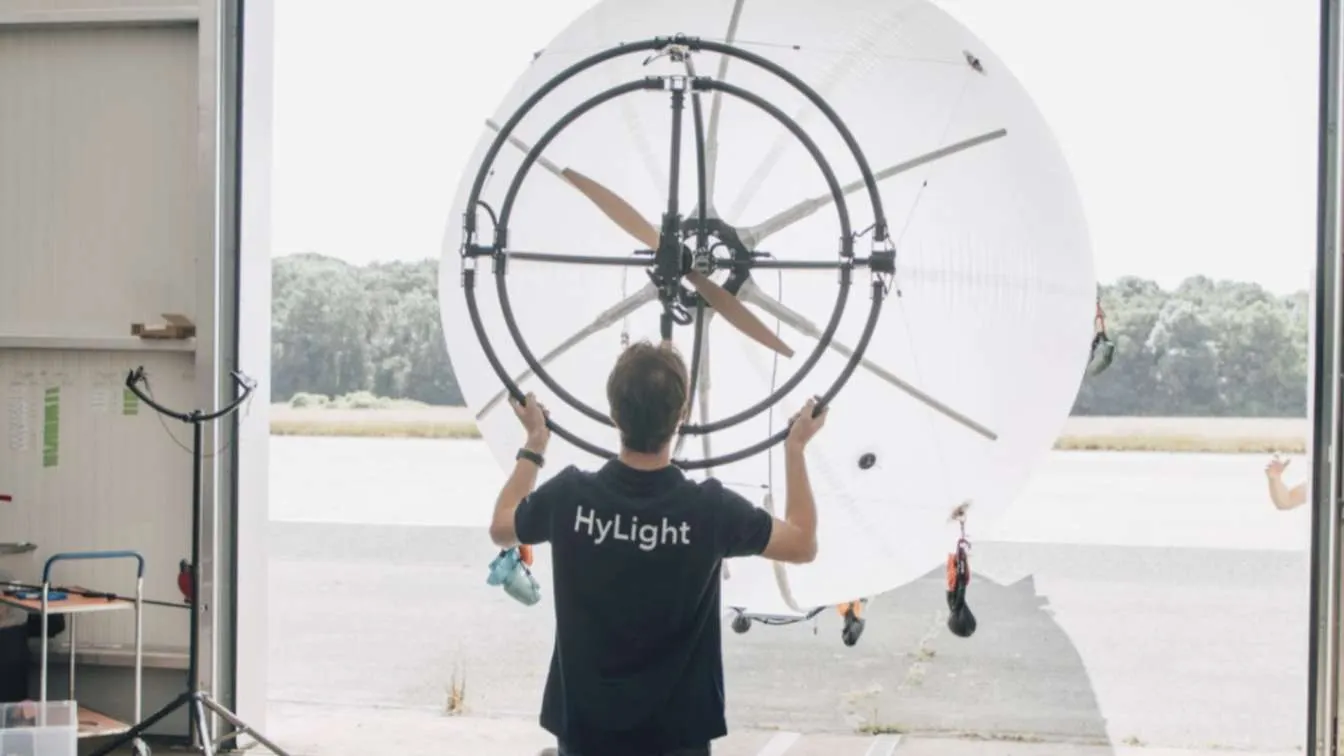
The aircraft, called the HyLighter, is an unmanned airship about 12 metres long. Helium keeps it in the air, while a hydrogen fuel cell, which turns hydrogen into electricity and gives off only water, powers its electric motors. Because the helium provides the lift, the motors only have to push the airship forward, which is why it can stay up far longer than a battery-powered drone of similar size. It flies about 25 metres above the ground along a power line or pipeline, carrying up to 10 kilograms of equipment.
That equipment can include high-resolution cameras, methane detectors and LiDAR (light detection and ranging), a laser scanner that builds a 3D map of everything below. HyLight says its cameras capture detail down to 1 millimetre per pixel from 25 metres, and that its laser scans record more than 1,000 points per square metre.
“No one else has 10 hours of flight time, 350 kilometres of range, and 10 kilograms of payload,” Bocken said. HyLight says the HyLighter is certified to operate in Europe and can fly beyond the sight of its remote pilot over infrastructure in rural, suburban and urban areas.
HyLight’s software analyses what the airship collects and flags trees growing too close to lines, as well as more than 50 types of fault on electricity networks. Maintenance teams receive short reports showing where each risk sits, with pictures as evidence, instead of large batches of raw images to sort through. The fleet has flown more than 750 hours so far, according to the company.
France’s Utilities Sign Up
HyLight’s early customers are among France’s largest network operators. They include Enedis, which runs most of the country’s electricity distribution network; SNCF Réseau, the rail infrastructure arm of the national railway SNCF (Société nationale des chemins de fer français); and the gas pipeline operators NaTran and Téréga.
Téréga is testing the airship on a 107-kilometre stretch of pipeline between Cazilhac and Claira in the Occitanie region of southern France, using it to look for methane leaks. Six flights are planned for 2026, subject to regulatory approval. Methane, the main component of natural gas, is a powerful greenhouse gas, and small leaks along buried pipelines are hard to spot from the ground.
Enedis plans to inspect 15,570 kilometres of line by airship in 2026, against 120,000 kilometres by helicopter, according to Tech Funding News, so helicopters will still do most of the work. Separately, Morning Tick has reported on efforts to secure connected equipment at remote substations and pump stations.
Replacing The Helicopter
HyLight says a helicopter can emit up to one tonne of carbon dioxide (CO2) equivalent for every hour it flies, and an Airbus H125, a common light helicopter, burns about 200 litres of kerosene an hour. Helmer Schukken, managing partner at Rubio Impact Ventures, said HyLight “offers a clean and scalable alternative that does the same work reliably, even over densely populated areas.”
The company estimates there are more than 80M kilometres of power lines, pipelines and railways worldwide. Bocken said HyLight has no direct competitor, although others are chasing the same work. Kelluu, a Finnish company that also flies hydrogen-powered airships, raised €15M in April 2026 in a round led by the NATO (North Atlantic Treaty Organization) Innovation Fund, and the Spanish drone maker FuVeX raised €3M in August 2026. The wider market for inspection drones is worth about $13.63B in 2026 and is expected to reach $25.82B by 2030, according to the market research firm Research and Markets.
Bocken founded HyLight in 2021 with Théo Hoenen, growing it out of a university project. Bocken, now 28, started it straight after finishing his studies, and the company went through Y Combinator in summer 2023. Hoenen has since left, and Josef Rokůsek is chief technology officer, with Thomas Laporte as chief business officer. The team has grown to 42 people, up from 36 in the middle of 2026. HyLight has also been through accelerator programmes including SkyDeck at the University of California, Berkeley.
Scaling The Fleet
HyLight has not said when it expects to reach 15 aircraft, and its growth will depend on how many inspection contracts utilities are willing to sign. It plans to spend part of the new funding on AI (artificial intelligence) and automation.
For now, airships remain a small part of Enedis’s inspection work. The new aircraft, the new factory and the first flights in Germany and the Netherlands will show whether HyLight can turn its French customers into a wider business.