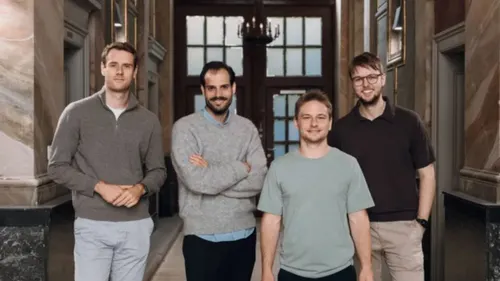
CarbonFarm, a Paris startup that uses satellite images and field data to check whether rice farmers have changed how they flood their fields, has raised €7M in a Series A round. Colam Impact, the impact investment arm of the family holding company behind the French electrical distributor Sonepar, led the round, according to the startup news site EU-Startups.
New backers include Proparco, the private-sector lending and investment arm of the French Development Agency, as well as Suma Capital, elea, Working Capital Fund, Albo and the French public investment bank Bpifrance. Racine², a fund run by Serena and makesense, returned alongside Techmind, which runs the Jeriko fund. Both led the company’s €2.5M seed round in October 2023.
CarbonFarm plans to use the money to expand in Asia, Africa and Europe and to grow faster in Latin America. It will also invest in its technology and in certifying rice projects for regulated carbon markets and for companies cutting emissions in their supply chains. “Scale will not come from replacing local value-chain players; it will come from equipping them,” said Vassily Carantino, its co-founder and chief executive.
Why Rice Paddies Release Methane
Most of the world’s rice grows in fields kept under water for much of the season. With the soil flooded and starved of oxygen, microbes break down plant matter and give off methane, a greenhouse gas that traps far more heat than carbon dioxide over the first couple of decades after it is released.
The Climate and Clean Air Coalition, a United Nations-backed partnership, puts rice cultivation at about 8% of human-caused methane, or around 40M tonnes a year, while the International Rice Research Institute puts the share at 10% or more. Cutting methane quickly is central to the Global Methane Pledge, under which signatory countries aim to reduce human-caused methane by 30% from 2020 levels by 2030.
A water-saving practice called alternate wetting and drying (AWD) offers a way to cut those emissions. Farmers let the field dry until the water sits about 15cm below the soil surface, then flood it again, using a perforated tube pushed into the ground to check the water level. The rice institute says the method can cut methane by 30% to 70% and water use by about 30% without lowering yields.
Checking Thousands Of Small Plots
The hard part is proving that thousands of smallholders actually drained their fields, and that is the problem CarbonFarm says it addresses. Its software applies artificial intelligence (AI) to satellite imagery, combines it with data collected in the field and runs emissions models to estimate how much methane each plot has avoided. The company says it developed the technology with Cornell University, France’s National Research Institute for Agriculture, Food and Environment (INRAE) and the European Space Agency.
“In certain countries, our models can be over 90% accurate, but results are location-specific,” Aparna Raturi, CarbonFarm’s chief operating officer, told the sustainability site Green Queen.
The company has not said which satellites it relies on, but frequent images of farmland now come both from commercial operators such as Planet Labs and from free public programmes such as the European Union’s Copernicus satellites.
CarbonFarm does not sign up farmers directly. It works through cooperatives, rice mills, agribusinesses, charities, governments and local project developers, and it also helps arrange financing, certification and buyers for the resulting credits. It says its projects follow existing methodologies such as Verra’s VM0051 for rice and are checked by accredited third-party auditors.
“We don’t replace local players. We equip them,” Raturi said.
Carantino, a former McKinsey consultant, and chief technology officer James Hastwell, a former head of data science, set up the company in 2022, according to its seed announcement. CarbonFarm now says it works in 19 countries, with Vietnam, India and Thailand its largest markets, and lists Mars Food, Diageo, the rice companies Ebro and Tilda, the World Bank, the Asian Development Bank and Google among the organisations it works with.
Lessons From The Mekong Delta
From November 2022 to April 2025, CarbonFarm ran a pilot, backed by Australia’s Department of Foreign Affairs and Trade, with the Belgian non-profit Rikolto and the International Rice Research Institute in Dong Thap, Can Tho and Kien Giang provinces. According to a project summary, it covered more than 900 hectares and 1,200 households and cut methane by 20% to 30% per hectare. The summary said registration with the Gold Standard certification body was still pending.
The pilot ran alongside a much larger national effort. In November 2023, Vietnam’s government approved a plan to grow 1M hectares of high-quality, low-emission rice in the Mekong Delta by 2030, with World Bank support and a system for measuring emissions cuts so they can be sold as carbon credits. By April 2026, the programme covered about 355,000 hectares, nearly double its 2025 target.
Hastwell said buyers increasingly want to see how results were reached. “Projects that can show clearly how their results were scientifically measured build greater confidence,” he said, adding that “independent, field-level evidence is becoming the expectation”.
A Market Still Rebuilding Trust
In August 2024, the carbon registry Verra rejected 37 rice projects in China that had used an older method, citing weak evidence that the cuts would not have happened anyway, as well as overstated project areas. It also sanctioned the developers and auditors involved. Verra released VM0051, its replacement rice methodology built around remote-sensing checks, in February 2025.
The Integrity Council for the Voluntary Carbon Market, which grades carbon-credit methods, approved the updated VM0051 in August 2026 but noted uncertainty in the methane modelling and possible trade-offs with nitrous oxide, another greenhouse gas. Earlier, in January 2026, it had attached conditions to its approval of the Gold Standard’s rice method, observing that AWD may spread in parts of Asia without carbon finance, which would make some credits hard to justify.
Rize, a Singapore company set up by the state investor Temasek and partners, also works on rice emissions and raised $31M in July 2026 to help farmers in Indonesia and Vietnam adopt lower-emission methods. Mitti Labs, which works with farmers in India, raised $9.5M in August.
Measured Cuts, No Credits Disclosed Yet
CarbonFarm has not said how many credits its projects have issued, how many hectares it now monitors or what share of credit revenue reaches farmers under its current contracts. Its Vietnam pilot was still awaiting registration when the project summary was published.
The round pays for the kind of plot-level measurement that earlier rice credits were faulted for lacking, and it arrives as the bodies that set the rules for those credits ask projects to prove their cuts field by field.