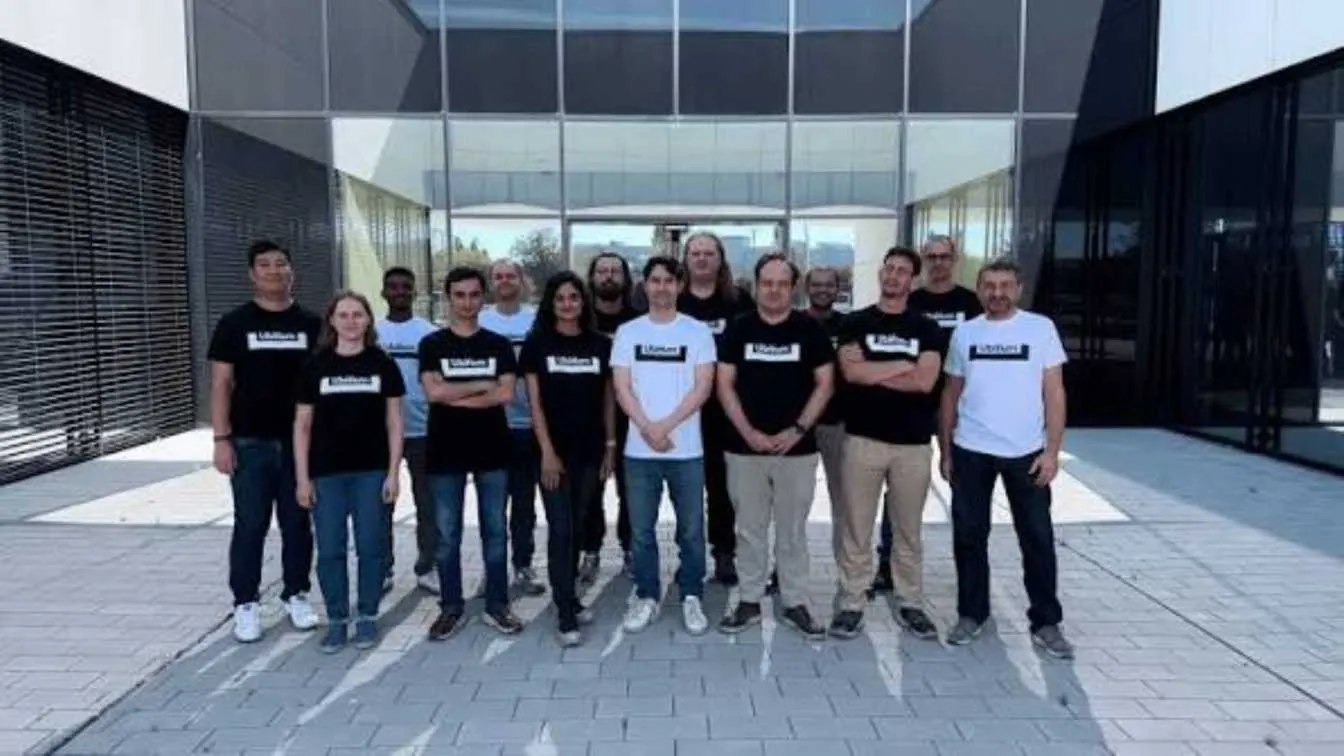
Ubitium, a chip startup in Düsseldorf, Germany, has raised $14M to turn its first test chip into a commercial processor for robots, drones, vehicles and industrial machines. Ibex Investors, a US venture firm, led the seed round. The European venture firm OpenOcean joined the round, along with earlier backers KBC Focus Fund, Runa Capital and Inflection, and Florian Seibel, co-founder of the German drone maker Quantum Systems, who invested personally.
The money takes Ubitium’s total seed funding to $18M since it was founded in 2024. The new money will go towards the UB410, the company’s first commercial chip. Ubitium plans to send the UB410 design for manufacturing and deliver the first evaluation units to customers in 2027.
A machine such as a delivery robot or an inspection drone usually needs several kinds of chip. A general-purpose processor runs the software, a signal processor cleans up data from cameras, radar and microphones, and an artificial intelligence (AI) accelerator recognises what the sensors see. A programmable chip often handles fast control of the motors.
Ubitium says one of its processors can do all of these jobs, which would let manufacturers design around a single chip and a single set of software tools.
“Physical AI machines bring a whole new set of computing challenges, and the inference isn’t the hardest one,” said Hyun Shin Cho, Ubitium’s co-founder and chief executive. “Sensing the real world and controlling the machine in it are just as hard, and today those still run on separate chips.”
One Grid That Changes Shape
A central processing unit is good at following instructions one after another. A graphics processing unit (GPU) runs thousands of identical calculations side by side, and a digital signal processor is tuned to filter streams of sensor data. A field-programmable gate array (FPGA) can be rewired after manufacture, but it costs more and is harder to program than a fixed-function chip.
Ubitium’s design is a grid of identical small processing units whose connections can change while the chip is running. Set up one way, the grid behaves like a conventional processor and can run the Linux operating system. That mode is based on RISC-V, an open, royalty-free instruction set that defines how a chip reads software. Set up another way, the grid works through repeated calculations in a pipeline, as a signal processor or FPGA would.
A third mode, which works more like a GPU, was still in development in 2025. Software can divide the grid so that different parts run in different modes at once, and all of them share the same memory. Ubitium says developers can use standard RISC-V programming tools rather than a new language, though the GPU-style mode uses its own language, modelled on Nvidia’s CUDA software.
The company pitches the chip at physical AI, a term Nvidia popularised in early 2025 for AI that perceives the real world and acts in it through machines. In those systems, sensing, deciding and moving all have to happen within fractions of a second, and machine makers have usually combined several specialised chips to meet those deadlines.
From Test Chip To Product
Ubitium’s first chip, the UB108, has 256 of the small processing units and is made on Samsung’s 8-nanometre manufacturing process. The company sent the design for manufacture in December 2025, received first silicon in July 2026 and says it has since shown signal processing, AI inference and real-time control running on the same grid. “We built one Physical AI processor that does all three, proved it in silicon in a year,” Cho said.
The UB410 is a much larger chip, with 4,096 processing units arranged across four cores. Ubitium told chip analysts in 2025 that it was aiming for about 5 watts of power, a peak of 30 trillion 8-bit AI operations a second and a chip area under 30 square millimetres. These are design goals for a chip that has not yet been manufactured, and Ubitium has not published benchmark results for the UB108.
The schedule has also moved. In August 2025, Ubitium and its South Korean design partner ADTechnology described the UB410 as the chip heading to Samsung’s factory, with volume production aimed at late 2026 to early 2027. The first silicon turned out to be the smaller UB108, and the UB410’s manufacturing start is now planned for 2027.
Ubitium says its first customers work on high-resolution radar and audio systems, with drones and other autonomous machines as the longer-term target. It has not named any customer.
Old Ideas, New Company
Cho previously worked as a technology executive in the automotive, industrial and building sectors, including at ThyssenKrupp. His co-founder Martin Vorbach, the chief technology officer, holds more than 200 patents. Vorbach founded PACT XPP Technologies, a Munich company that launched a reconfigurable processor array called XPP around 2000. The third co-founder, Peter W. Weber, spent part of his career at chipmakers including Texas Instruments and Intel.
Earlier reconfigurable array processors, PACT’s among them, struggled to win customers. PACT’s patents did bring in money: the chipmaker Xilinx paid it $33.5M in December 2013 to settle a patent dispute. Ubitium’s version pairs the reconfigurable idea with the RISC-V instruction set, standard software tools and Samsung’s 8-nanometre process. Ubitium works from its Düsseldorf base, a research centre in Rülzheim and an engineering centre in Karlsruhe.
Ibex invests in mobility, including automotive, aerospace, logistics and manufacturing, and KBC Focus Fund is a Belgian fund for microelectronics and connected devices. Quantum Systems, the drone maker Seibel co-founded and co-leads, supplies reconnaissance drones to forces in North Atlantic Treaty Organization countries and Ukraine, and raised $1.2B in July 2026.
An autonomous machine “has to process its surroundings, make decisions and control itself on board, within strict limits on power and weight”, Seibel said. “Ubitium is building the one processor that does that whole job.”
A Crowded Field At The Edge
Several European and Israeli chip companies are chasing AI in devices rather than data centres. Axelera AI of Eindhoven, the Netherlands, raised more than $250M in February 2026 for its AI accelerators. The Israeli chipmaker Hailo cut about half its staff in June 2026, and in July it agreed to be acquired by the US chipmaker Microchip Technology. Axelera and Hailo both sell AI accelerators that work alongside a separate main processor.
Ubitium is closer to companies built around programmable designs, though those license their designs rather than sell chips. Analog Devices bought Flex Logix, which licensed reconfigurable circuitry and AI designs, in November 2024. Quadric, based in Burlingame, California, licenses a programmable AI processor design called Chimera. Robot makers can also buy ready-made computers such as Nvidia’s Jetson Thor, which combines processor cores and a Blackwell GPU on one module.
Proof Still Due In 2027
Ubitium has shown its approach working on a small test chip. The processor it plans to sell has not yet been manufactured, the company has not named any customers, and its power and performance figures remain the company’s own targets.
The $14M gives it the runway to build the UB410 and put evaluation units in customers’ hands. Those units will be the first independent chance to see whether a single reconfigurable chip can do the work of several.