Bolt Graphics is in talks to raise about $100M at a valuation of around $700M, but it has not closed the round or confirmed any new money yet. Three people familiar with the talks described the plan, and the numbers could still change. The cash would help turn the graphics chip Bolt has spent roughly six years designing into something it can sell.
Darwesh Singh, who founded the Sunnyvale, California, startup and is its chief executive and chief technology officer, declined to discuss the size or price of the round but said the fundraising was “well under way”. No lead investor has been named.
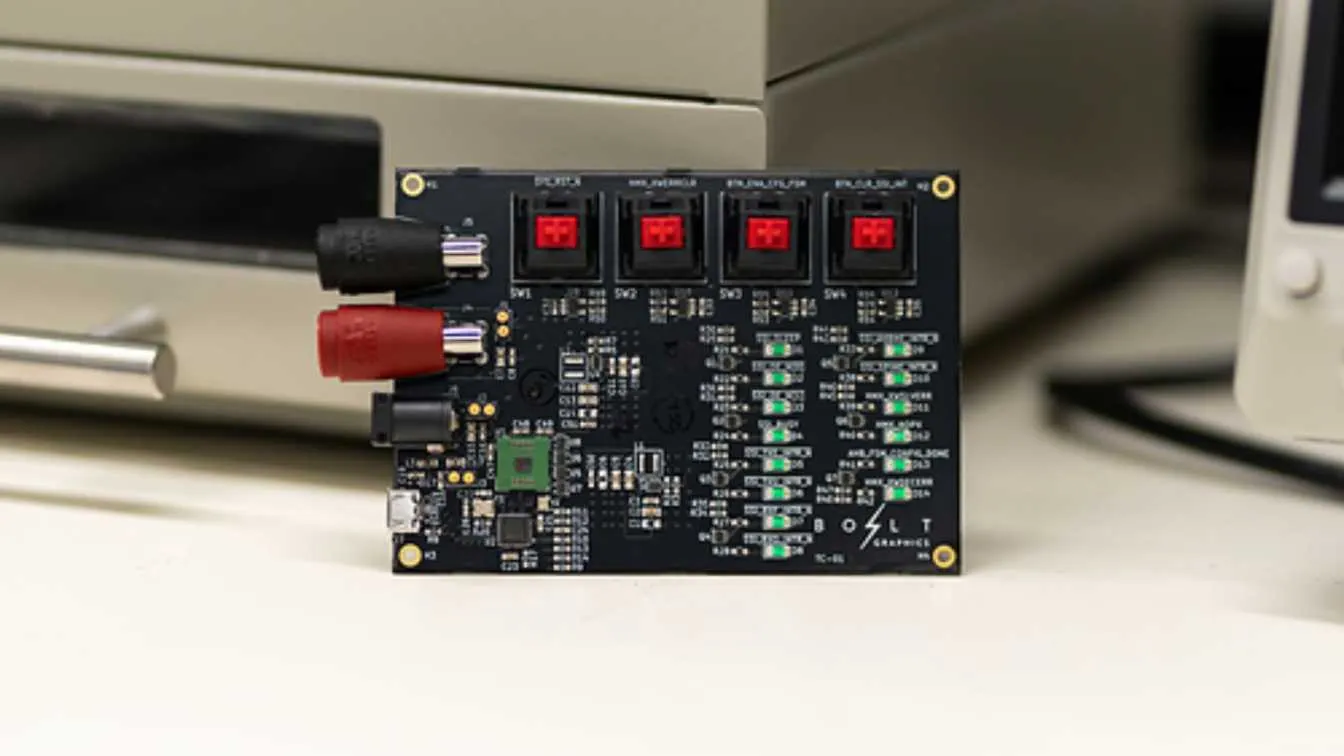
The money is meant for Zeus, a GPU that Bolt has built for path tracing, a way of drawing images by tracing how light bounces around a scene, and for scientific simulation. This week the company said its first Zeus test chip was up and running, the first time its design has worked on real silicon.
A Chip Bet Outside AI
Bolt is not building its chip for artificial intelligence (AI). It wants to sell to scientists who need very precise calculations, and to people who make 3D graphics. Professional users such as 3D artists and game developers come first, with graphics cards for gamers planned for later.
That makes the round a test of whether investors will back a chip startup working outside AI. Chip companies have long struggled to raise money because their products cost a lot and take years to reach the market, though that is shifting. Crunchbase counted about $10.7B going into semiconductor startups by early June 2026, putting the year on track to beat 2025.
Other chip startups are asking for far more. Nuvacore, a young San Jose company designing processors for AI data centres, is reportedly raising money at a $2.5B valuation. Bolt’s target is smaller, and it is going after a narrower set of customers.
Singh founded Bolt in 2020, after about a decade designing data centres and cloud systems. The company says it closed its first funding round in 2021 and a second in 2022, but it has not said how much it raised or who invested.
What The Zeus Chip Is Built To Do
Path tracing produces the most lifelike computer images, which is why film studios use it for visual effects. It takes so much computing power that rendering can drag on for hours, and in games it can cut frame rates sharply. Bolt says Zeus can path trace at 4K resolution and 120 frames per second.
Bolt’s website names four fields it is designing for: architecture and design, film and television, gaming, and high-performance computing, the heavy number-crunching behind scientific research. Its own path-tracing software, Glowstick, is meant to work with 3D tools such as Blender and Autodesk Maya.
Under the hood, Zeus mixes general-purpose processor cores based on RISC-V, an open set of basic instructions that any company can use without paying licence fees, with cores for vector maths and other specialised units. The chip comes in one, two or four connected pieces, called chiplets, with the largest version made for servers.
Each Zeus card pairs low-power memory soldered onto the board with slots for ordinary plug-in memory modules, giving up to 384GB on a single card, and a server unit can hold up to 2.25TB. Nvidia’s GeForce RTX 5090 gaming card, by comparison, has 32GB. Every card also has a built-in 400 gigabit Ethernet port for linking machines together.
First Silicon And A Later Launch
The test chip was made by Taiwan Semiconductor Manufacturing Company (TSMC) on its 12-nanometre process, an older and cheaper generation of its manufacturing technology. Bolt sent the design to the factory in April, and the finished chip measures about 6 square millimetres. It draws about 1.4 watts, compared with 35 watts on the field-programmable gate array (FPGA), a reprogrammable chip Bolt had been using to test its design.
According to Bolt, engineers had the chip working within 24 hours, and it showed no functional problems in tests from minus 40 to 85 degrees Celsius. It speeds up path tracing and electromagnetic simulation, which uses Maxwell’s equations to model how light and radio waves behave in designs such as silicon photonics, optics and stealth shapes.
Singh said engineers have long faced a choice: model parts one at a time, or build a physical prototype of the whole product. “Running Maxwell’s equations on our silicon eliminates that tradeoff,” he said, calling electromagnetics “our starting point”. Bolt also wants to speed up fluid dynamics and molecular dynamics, two other kinds of scientific simulation.
The full Zeus chip is further away than Bolt first said. In early 2025 it expected developer kits in the second half of that year and mass production in the second half of 2026. By April 2026 it was aiming to start production in late 2027 instead. It now plans developer access in the first quarter of 2027, hardware for early access customers in late 2027, and volume production of plug-in cards and servers in 2028.
The final chip will move to N5P, a more advanced TSMC process from its 5-nanometre family, which Bolt says it picked to avoid competing with other customers for wafer supply. It has also opened an office in Taipei to work beside its suppliers. Lawrence Lee, its vice president of manufacturing operations, said being there lets the team “keep a pulse on the progress”.
Bolt’s Claims Against Nvidia
Nvidia and AMD make the graphics chips that most studios, gamers and research labs use, and Bolt has measured Zeus against Nvidia. When it unveiled the chip in early 2025, it said the largest version could deliver up to 10 times the path-tracing performance of the RTX 5090.
The company also says Zeus runs electromagnetic simulations about 300 times faster than Nvidia’s B200 data centre chip, at full 64-bit double precision (FP64), the level of accuracy scientific work often needs. Every Zeus chip, including those for consumers, carries full FP64 hardware, according to Singh.
Those figures are Bolt’s own, and they were worked out before any Zeus silicon existed. The company has not published independent benchmarks from the new test chip, which is far smaller than the planned product. It says more than 14,000 businesses, developers and users have joined its early access programme, though it has not named customers.
Where Bolt Graphics Stands
Bolt now has working test silicon, a new office near its chipmaker and a later launch date for the chip it actually plans to sell. The funding terms come from people familiar with the talks, and the round has not closed.
What Zeus can do in practice remains largely the company’s word against products that are already shipping. Developer access, planned for early next year, would give outsiders their first hands-on look at the hardware Bolt hopes will take on Nvidia and AMD outside AI.