Solvera, a young engineering firm in Oslo, Norway, that designs the ventilation, heating, plumbing and electrical systems inside buildings, has raised $6.3M in a pre-seed round. Seedcamp, a European seed investor that backed Revolut and Wise in their early days, led the round.
Construct Venture, the venture arm set up by the contractor AF Gruppen and the housing developer OBOS, joined in, along with OBOS Ventures, Inception Fund, Momentum, PSV Tech, Sondo and The Nordic Web Ventures. Anders Kvåle and Håvard Haukeland, founders of the Oslo startup Spacemaker, invested as individuals. Solvera will spend the money on a bigger engineering and technology team in Oslo, a London office and its own software.
Solvera calls itself an AI-native engineering firm. It does not sell a design tool to engineers; it takes on the engineering job itself and, its website says, charges a fixed price for the result rather than for licences or billable hours.
“We are building the engineering firm itself around AI,” said Arif Mirza, its co-founder and chief executive.
Agents Draft, Engineers Sign Off
The company starts with mechanical, electrical and plumbing (MEP) engineering, the trade that plans a building’s air ducts, pipes, cooling, sprinklers and cabling. On its website, Solvera says software agents built on its in-house system, SolveraOS, take on repetitive tasks such as sizing airflow, routing ducts and updating electrical circuits, and redo calculations and models when a project changes.
Solvera says it simulates each design option for energy use, airflow and loads, and pairs language models with physics-based calculation tools. It also says all the MEP trades are drawn together in one shared model from the first day, which it claims prevents pipes and ducts from clashing. These are company claims; Solvera has not published figures on time or cost saved.
Humans still sign off: Solvera says an experienced consulting engineer checks and approves every deliverable, and that the firm acts as the engineer of record, carrying formal responsibility for the design.
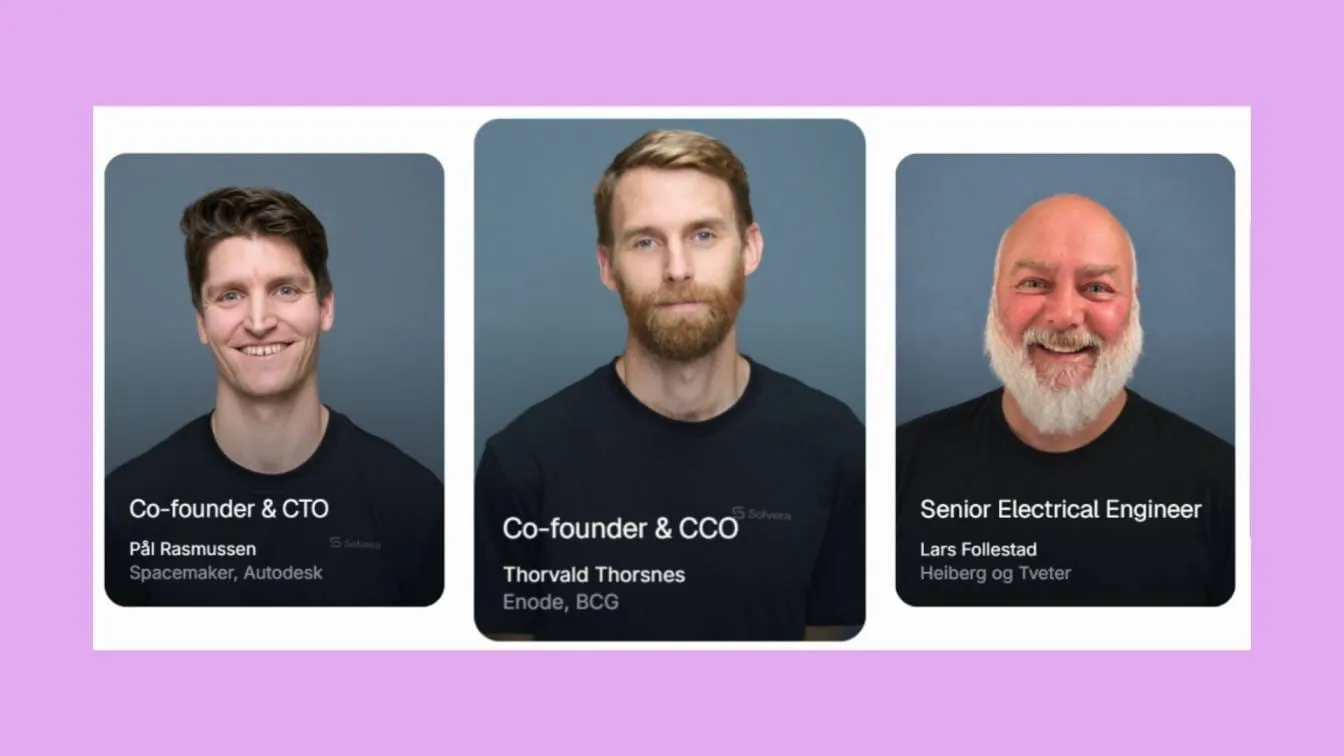
“The most valuable thing in building engineering has always been the engineer’s judgement,” said Pål Rasmussen, co-founder and chief technology officer (CTO).
First Contracts With Betonmast
Solvera began operating in July and says it passed $1M in contracted revenue in its first three months. Its customers include Betonmast, a Norwegian contractor that is part of AF Gruppen, which uses Solvera on several projects. Kristian Gjestemoen, managing director of Betonmast Buskerud-Vestfold, said fragmented engineering brings extra cost, slow iterations and problems found too late. “We don’t believe adding more hours will solve this,” he said.
The firm lists three projects in Drammen, a city south-west of Oslo. One is a new office building by Strømsø square in central Drammen, where Solvera is handling design from the early concept to detailed drawings. The other two are renovations of older buildings being stripped back to their shell or frame, where new systems have to fit around what is already standing.
Spacemaker Alumni Start Again
Mirza and Rasmussen both worked at Spacemaker, which used AI to help architects and developers test early site layouts. Autodesk, the maker of AutoCAD and Revit design software, agreed to buy Spacemaker for $240M in 2020, and both founders later worked at Autodesk. Mirza has also worked at the consultancy McKinsey & Company.
The third co-founder, Thorvald Thorsnes, is commercial director. He previously co-founded Enode, an Oslo energy software startup backed by Y Combinator, and worked at Boston Consulting Group. Solvera’s nine staff include consulting engineers for electrical work and for heating, ventilation and plumbing, plus an AI lead and three software developers. Six of the nine have worked at Spacemaker and Autodesk.
“Technology is only part of the answer,” Mirza said, adding that a firm also has to rethink how it operates and makes money to get the full benefit. Tom Wilson, a partner at Seedcamp, said construction “has absorbed two decades of tooling without shifting how the work actually gets delivered or paid for”.
Software Rivals Raise Bigger Sums
Endra, based in Stockholm, Sweden, goes after the same MEP work but builds software for existing engineering firms instead. It raised a $50M Series A this year, led by Andreessen Horowitz, with Notion Capital and Norrsken VC also investing. It has offices in London, New York and San Francisco as well as Stockholm.
Augmenta, based in Toronto, Canada, raised a $10M seed round led by Prelude Ventures in March 2025, taking its total to $25.6M. Its AI agent designs a building’s electrical systems, and it is developing agents for mechanical and plumbing work. Further along the building chain, startups such as reebuild in Vienna use AI to check builders’ invoices.
Solvera differs in that it delivers the design itself and carries responsibility for it, rather than selling a licence. Engineers are also hard to find in its home market: in the 2026 skills survey by the Confederation of Norwegian Enterprise (NHO), 52% of construction firms surveyed named engineering and technical skills when asked where they lacked expertise.
Where Solvera Stands
Three months into operations, Solvera has $6.3M from Seedcamp and investors tied to Norway’s building trade, a nine-person team, projects under way in Drammen and Betonmast among its clients. Where Endra builds software for existing engineering firms, Solvera takes on the engineering job itself, charging a fixed price for the result while its own engineers check and approve every deliverable.
Its next step is a London office, which would take that model of AI agents doing the routine design work, with engineers signing off, outside Norway.