
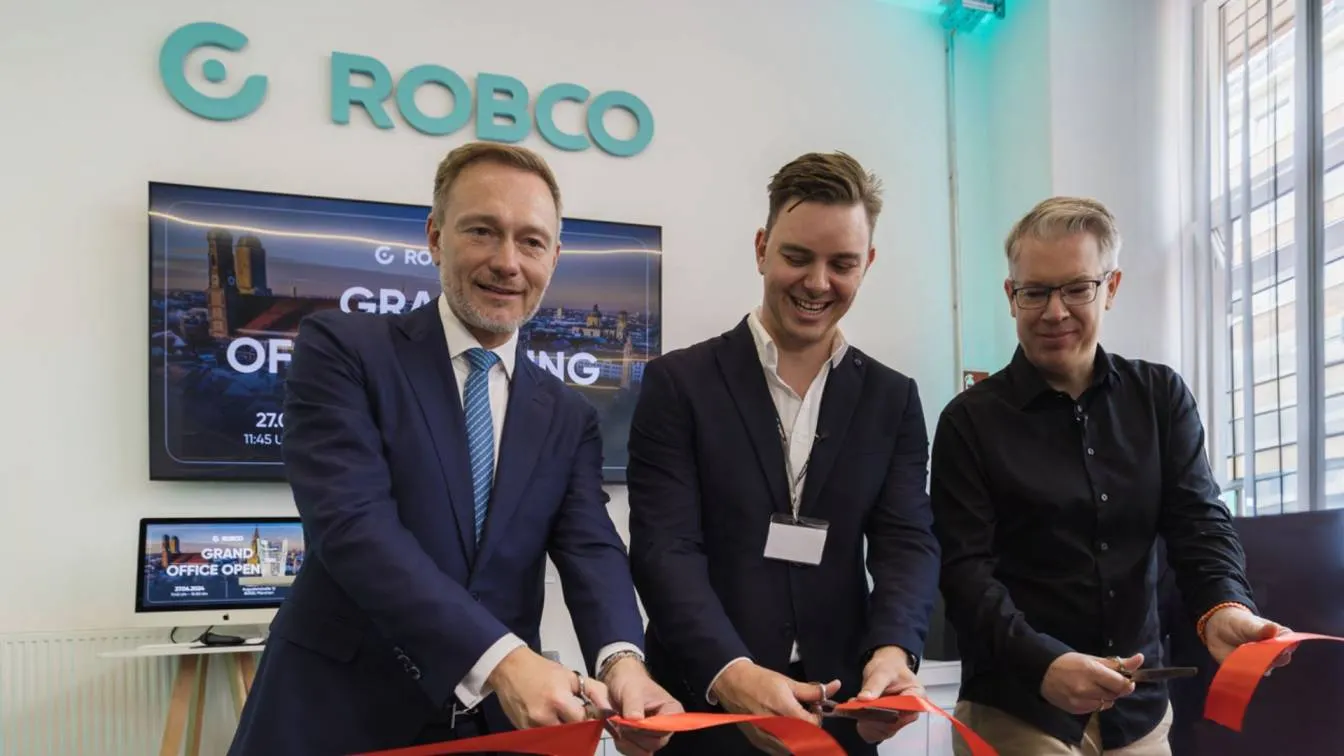
RobCo, a Munich company that rents modular robot arms to mid-sized factories, has been valued above $1B. That is nine months after a Series C priced the six-year-old firm at roughly half the figure.
The transaction is a $40M round, and most of it is secondary, meaning current and former employees selling shares rather than new money going onto the balance sheet. Cherry Ventures and European Tech Collective came in as new investors, while Sequoia, Lightspeed, Greenfield, Kindred, Lingotto and Promus Ventures, all of them already shareholders, took part alongside them.
What RobCo sells is a modular robot arm for factories that were never automated. The company builds single-joint arms for inspection work on a conveyor, multi-jointed arms that can reach around obstacles, and a heavy model carrying about 40kg over a reach of more than two metres for metalworking. Alfie is the newer machine, a two-armed mobile robot for jobs needing both hands at once, such as holding a car part steady while the other arm paints it.
The software is where the company places its argument. RobVision adapts a robot to a changed production line from uploaded photographs and synthetic training images, RobFlow lets a worker assemble a routine from pre-written motion commands without writing code, and RobCo Studio handles configuration and maintenance scheduling.
The commercial model follows from that. RobCo rents the robots rather than selling them, so a manufacturer takes on a subscription instead of a capital project, which is aimed squarely at mid-sized firms with no automation engineers on staff. The company names BMW, T-Systems, Rosenberger, DynaEnergetics and Fabricated Extrusion Company among its customers, where the robots load machines, stack pallets, apply coatings and weld.
Roman Hölzl founded the company in 2020 with Paul Maroldt and Constantin Dresel, all three of them research associates at the Technical University of Munich's robotics and artificial intelligence chair. "This is an important moment for RobCo," Hölzl said of the valuation, adding that the company had "used that moment to strengthen the company."
Luciana Lixandru, a partner at Sequoia, framed the investment around where the firm sees machine learning going. "RobCo is building for a future in which AI doesn't just reason and generate, but acts in the physical world," she said.
A Price, Not A Capital Injection
The structure is the part that distinguishes this from the Series C in January. That earlier round was $100M of primary capital, co-led by Lightspeed and Lingotto with Sequoia, Greenfield, Kindred and Leitmotif participating, and Hölzl said at the time it would fund a push to become the leading supplier of AI-driven robotics for manufacturing in the United States and Europe.
This one is smaller and differently shaped. A secondary sale moves existing shares from employees to investors, which hands early staff liquidity and sets a price, and the company keeps whatever primary portion was included.
Both things are real. The valuation is what an incoming investor agreed to pay for stock, and the amount reaching the business to build with is a fraction of the headline. That makes the $1B figure a statement about investor appetite more than about the company's balance sheet, arriving nine months after the round that actually capitalised it.
German Robot Sales Fell This Year
The home market has been moving in the opposite direction to the company's price. The International Federation of Robotics counted 5M industrial robots at work worldwide in its September report, with more than 600,000 installed during 2025, up 11%, and China took 59% of global deployments on 354,000 units.
Europe did not share in that. German installations fell 8% to fewer than 25,000 units, even though Germany remains the fifth largest market and takes 41% of everything installed in the European Union, while Italy dropped 11%, France 8% and Spain 15%.
The labour argument has softened too. The ifo Institute found in February that 22.7% of German companies reported a skilled worker shortage, the lowest reading in five years, down from 25.8% four months earlier. Manufacturing was below that average at 16.6%, with automotive and electrical equipment firms at around 10%, and Klaus Wohlrabe of the ifo Institute attributed part of the fall to weak economic conditions and part to technological change altering which skills companies look for.
Those two figures describe the pitch RobCo makes to a German factory owner. Fewer firms are struggling to hire, and fewer are buying robots, which narrows the opening a domestic automation vendor sells into.
America Became The Growth Market
The company's answer has been to move where the demand is. RobCo entered the United States in 2025 and now describes it as its fastest-growing market, with customers across more than a dozen states, manufacturing and assembly in Austin and a laboratory in San Francisco. Hölzl has relocated there to run the expansion, which is a notable step for a company founded out of a Munich university and still presented as a European robotics success.
The subscription model travels reasonably well to that market. American mid-sized manufacturers face the same shortage of automation engineering talent, and renting a robot arm avoids a capital approval that a smaller firm may not get.
What the move does not resolve is competition. The United States has its own robotics-as-a-service companies, and the established arm makers, from Universal Robots to Fanuc and ABB, sell into the same factories through long-standing distribution.
A Bigger German Robotics Bet Next Door
RobCo's milestone arrives in a year when another German robotics company has raised an order of magnitude more. Neura Robotics reached a €4B valuation in March after an investment led by Tether, then raised $1.4B by June at around $7B, with Qualcomm, Amazon and Nvidia among the backers, and it has said it intends to build 6,000 humanoid robots during 2026 and more than 10,000 in 2027.
The two companies are selling different things. Neura is funding a humanoid programme at a point when most Western firms have yet to reach commercial production, while Chinese manufacturers including AgiBot, Unitree and UBTech shipped more than 1,000 humanoids in 2025. RobCo is selling arms that load machines and stack pallets in factories that already exist, on a monthly fee, to customers with purchase orders, and the valuations attached to each reflect how far from revenue the respective bets sit.
What this round establishes is that investors will pay twice as much for RobCo as they did in January, and that the people who built it over six years can now sell some of what they hold. What it leaves unanswered is whether a rental model for factory robots grows fast enough in America to justify the price, in a year when the market that produced the company bought fewer robots than the one before.