
Hexafarms, a Berlin company that monitors commercial greenhouses with sensors and autonomous robots, has raised €4.8M in a seed round alongside a subordinated loan of up to €800,000. Ananda Impact Ventures and Green Generation Fund led the round, with Grey Silo Ventures, better ventures, Speedinvest, Mudcake, Techstars and the German agricultural bank Rentenbank also taking part.
The company does not sell the equipment. Growers pay a subscription that covers the software, the hardware, the installation and the maintenance, which keeps the capital cost on hexafarms' side of the arrangement.
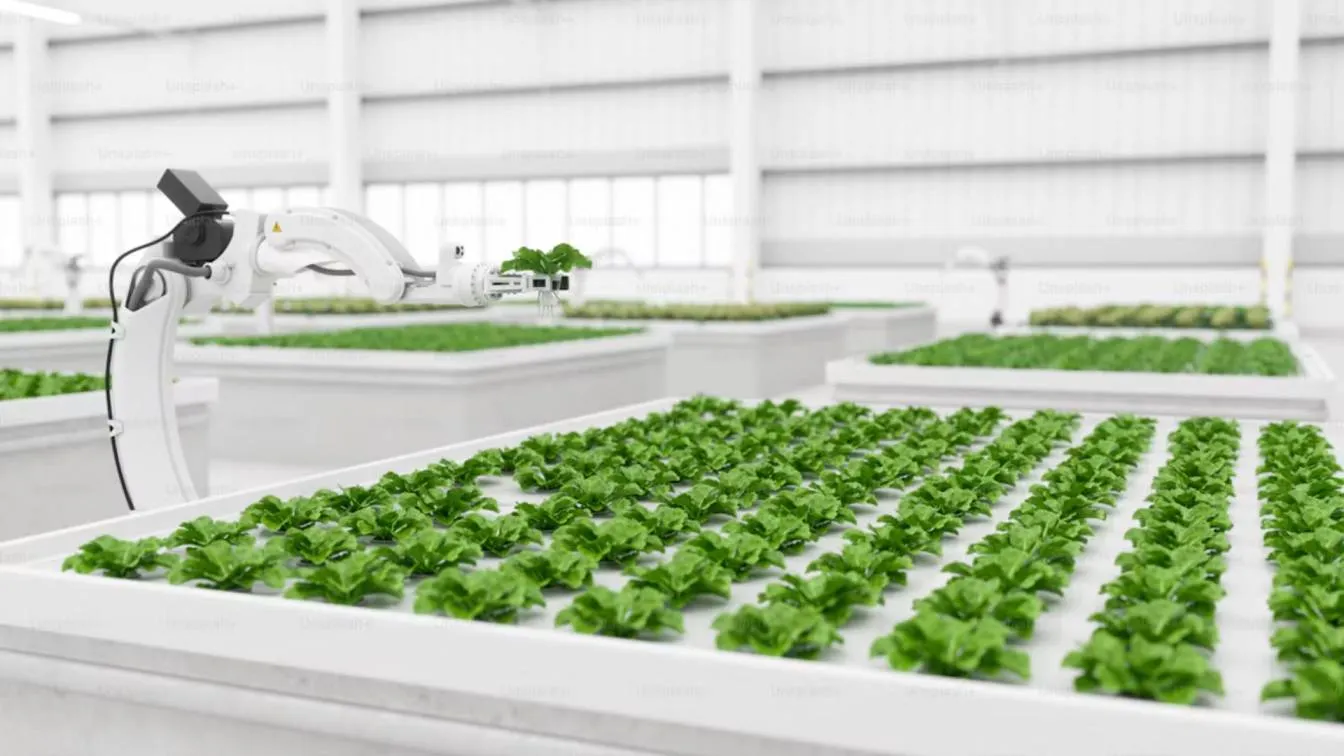
What that subscription puts in a greenhouse is two kinds of machine. Wireless sensors read climate, light, substrate conditions, drainage and fertigation every five minutes, while autonomous robots move through the crop each day, covering two to three hectares and looking for disease and pests. The software sits on top, processing more than 70 parameters to produce harvest forecasts across roughly 50 crop varieties, among them tomatoes, peppers, cucumbers, aubergines and berries.
Running that across borders brings its own problem. A greenhouse in Spain and one in the Netherlands sit on different mobile networks with different contracts, which is the same connectivity question that farm sensor deployments have had to solve before the data analysis ever begins.
Hexafarms says it now works with more than 50 farms across 13 countries, covering production worth about €300M a year, and its named customers include the fruit company SanLucar and the grower cooperatives Elo and Royal ZON. That is a considerable expansion from where the company stood two years ago: when it raised €1.3M in pre-seed funding in May 2024, it was working with around 14 growers across Germany, the Netherlands, Austria and Switzerland, mostly on tomatoes and strawberries.
David Ahmed founded the company with Felix Kirschstein, Huijo Kim and Abraham Hdru. The next markets it has named are the German-speaking countries, the Benelux region and Spain.
Money In A Difficult Year
The timing of this round says as much as the amount. Agtech venture funding has been contracting sharply, and the first half of 2026 brought 263 deals worth $2.4B, with the second quarter recording 107 deals, the lowest quarterly count on record. For comparison, the sector closed 875 deals across the whole of 2025, so the current trajectory points to a decline of roughly 40%.
Exits have been scarce enough to keep that pressure in place, with 30 exits worth $623.2M in the first half. Alex Frederick, PitchBook's lead agrifoodtech analyst, has described 2026 as the bottom of the cycle rather than the start of a recovery, with no clear rebound expected before 2027.
One category has held up inside that decline. Precision agriculture took about a third of agtech venture value, and Frederick's explanation points directly at what hexafarms sells. "Precision ag was the standout this quarter," he said, because "it sits directly on the two costs farmers most want to cut right now, labor and inputs." Capital, he added, is following measurable returns in water saved, labour hours reduced and inputs cut.
Crop scouting is labour by definition. Somebody walks the rows looking for the first signs of disease, and in a greenhouse of several hectares that is a daily job which gets skipped when staff are short.
The Software Rivals Are Ahead
Hexafarms is entering a market where several companies already have scale, and the nearest comparison is Dutch. Source.ag raised a €15.2M Series B in November, taking its total past €52M, and its software runs in more than 300 greenhouses covering 2,500 hectares across 18 countries, doing yield forecasting and irrigation automation, and selling software alone.
Others occupy neighbouring ground. Blue Radix sells autonomous greenhouse management, ecoation builds a scouting robot called OKO that also forecasts yield, and the Dutch climate computer makers Priva, Hoogendoorn and Ridder already sit in most large greenhouses as the systems that physically control vents, screens and irrigation.
Against that, hexafarms is distinguished less by what its software does than by what it brings with it. Owning the sensors and the robots means it controls the data the models learn from rather than reading whatever the existing climate computer exposes.
A robot that inspects plants and flags disease also moves the company closer to the harder half of this market. Reading conditions is one job and acting on what the reading shows is another, and the step from sensing to acting is where most agricultural automation has stalled, since a wrong decision costs a crop rather than a report.
The cost of that choice sits on its own balance sheet. A subscription covering hardware, installation and maintenance means the company carries the equipment spend and the service obligation, which is a heavier business to run than selling software into systems somebody else installed. It also makes the figure worth watching straightforward: fifty farms across 13 countries is a small base to support a fleet of robots in the field, and the economics improve only as the number of greenhouses per engineer rises.
Greenhouses Kept What Vertical Farms Lost
The investment case for this type of company has shifted considerably in three years. Vertical farming absorbed enormous capital and produced a run of failures, which left investors wary of controlled environment agriculture as a category.
Greenhouses came through that better, because the economics were never dependent on lighting an entire crop from scratch. A commercial greenhouse already produces at scale and already runs on thin margins, which makes a percentage point of yield or a reduction in crop loss worth paying for. That is the opening hexafarms is working in, and the round suggests investors still believe in software and sensors attached to existing production rather than new production built from nothing.
What the next two years will show is whether a subscription covering robots can hold its margin as it spreads across more countries. Source.ag has demonstrated that greenhouse software scales internationally; nobody has yet demonstrated that greenhouse robots do, and hexafarms has taken on both questions at once.