
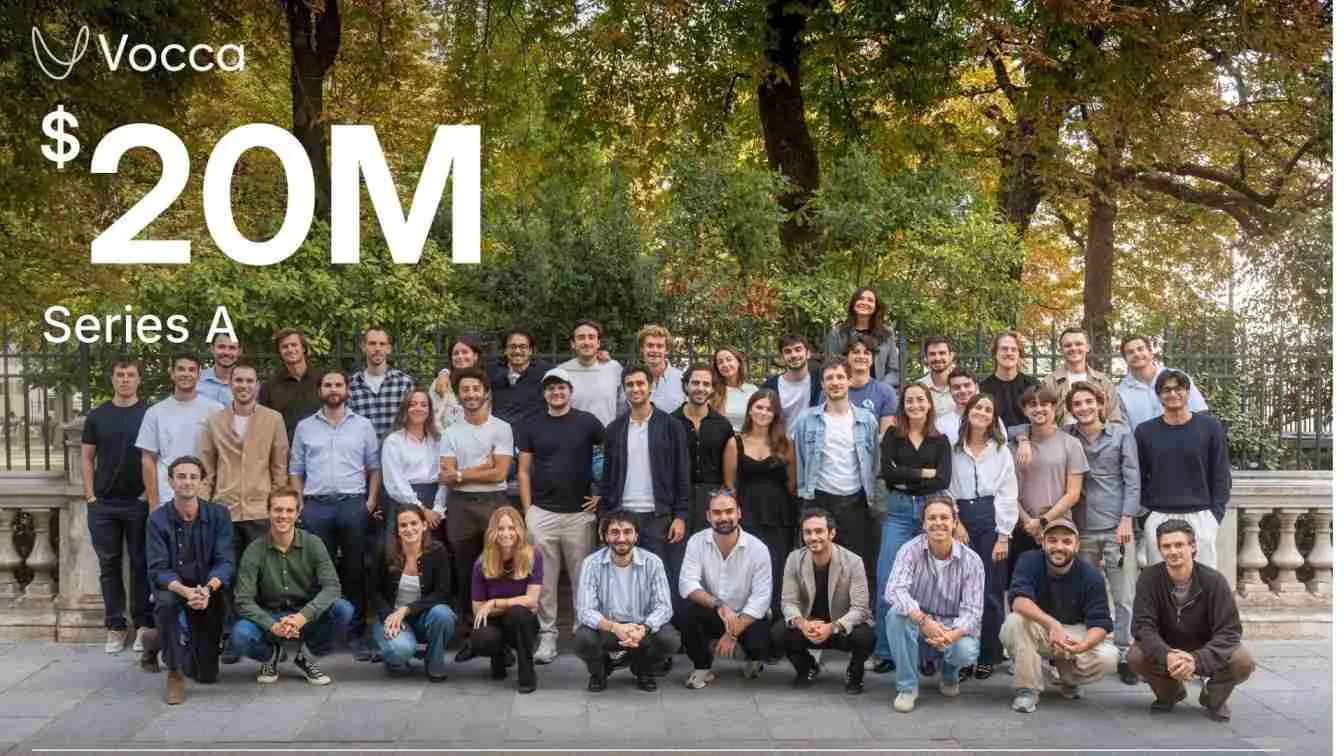
Vocca, a company that answers the telephone for medical practices from offices in Paris and New York, has raised $20M. The round was led by Norrsken VC and takes the total raised to $25M, a little over two years after Eliott Hoffenberg and Hugo Danet founded the company in July 2024.
Heal Capital, Speedinvest and Firstminute Capital joined the round, alongside angel investments from founders of the insurance company Alan and the monitoring software firm Datadog. Its first institutional round closed only in September 2025.
The product picks up the phone instead of a receptionist. It takes new patient details, books and confirms appointments, and answers administrative questions. More than 1M inbound conversations a month run through it, across about 1,500 practices and over 20 medical specialties.
Underneath it sits a deliberately split design. A language model handles the conversation, while a separate rules engine decides what can actually be booked. That engine is written specialty by specialty, and it behaves the same way every time rather than generating an answer.
Several large French providers are named as customers. Hôpital Fondation Adolphe de Rothschild has more than 300 physicians and sees 350,000 patients a year. The list also holds DAG Dental's 37 practices, Point Vision's 67 eye clinics and 60 imaging centres run by Résonance Imagerie.
What The Growth Number Counts
The headline figure is a jump from 2,000 practitioners to 15,000 in roughly a year. That figure counts individual clinicians covered rather than contracts signed, and the same disclosure puts the practice count at about 1,500.
Dividing one by the other gives the shape of the business. Around ten practitioners sit behind each practice on average, so the customer base is closer to 1,500 buying decisions than to 15,000. A single hospital with 300 physicians moves the practitioner count further than a hundred dental surgeries do.
Revenue is described only as a multiple. Vocca says conversation volume grew tenfold over the year and revenue sevenfold, without publishing the figure either measure started from.
That gap matters for reading the round, because a company a year past its first institutional round can post large multiples from a small base. The $20M is the market's assessment of the trajectory rather than confirmation of the scale.
The Resolution Rate Is Self-Reported
The operational claim is more interesting than the growth one. Vocca says it resolves an average of 70% of inbound calls end to end without a member of staff. That figure rises above 85% in mature deployments within a single specialty, and the company reports more than 75% at the Rothschild hospital.
Those are the numbers a practice manager would actually buy on. They are also entirely vendor-reported, with no independent audit published and no public definition of what counts as resolved.
The definition is where the ambiguity sits. A call that ends with an appointment booked is clearly resolved. A call that ends with a message taken for a person to deal with later could be counted either way, and the difference changes the staffing saving considerably.
What the company does disclose is its compliance position. It holds SOC 2 and ISO 27001, two audited security standards, along with the French HDS certification required to host health data. European data stays in the European Union and American data in the United States, and Vocca signs up as a business associate under HIPAA, the American medical privacy law, which binds it by contract to the same handling rules as the clinic.
A Much Bigger Rival Already Exists
The category Vocca is entering has a well-funded leader on the other side of the Atlantic. Assort Health raised $120M in June 2026 at a $1.2B valuation, taking its total to $222M, and says its revenue grew twentyfold in 15 months.
Its argument for defensibility is accumulated data rather than the model. Assort cites 190M patient interactions, along with 62,000 clinic rulebooks and 1.6M mapped routes a call can take. Its argument is that demonstrations are now easy to build, and the difficulty lies in handling the exceptions.
The rest of the field is crowded and expensively funded. EliseAI has raised $250M, Tennr $101M, Artera $65M and Prosper AI $30M, all selling automation into the same administrative gaps in healthcare.
Vocca's $20M buys a position in Europe rather than a contest for the American market. Its separation of the language model from the scheduling rules and its European data hosting are what distinguish it from companies with ten times the capital.
Europe Now Requires Disclosure
A rule that took effect this summer applies directly to what Vocca sells. Article 50 of the European Union's AI Act became enforceable on 2 August 2026, and it requires that systems interacting directly with people, voice assistants among them, are built to tell the person that they are talking to a machine.
The penalties are set at a level that reaches small companies. Breaches carry fines of up to €15M or 3% of worldwide annual turnover, whichever is higher, and the rule covers providers outside the bloc whenever the output is used inside it.
For a patient calling a clinic, that turns a product decision into a legal one. Whether the voice announces itself at the start of the call is no longer a matter of design preference in Europe. It is the familiar pattern of rules arriving after a product category has already been deployed at scale.
What The Round Does Not Say
Several things a buyer would want remain undisclosed. Vocca has not published its pricing, its error rate or its procedure for when the system mishears a patient. A misbooked appointment in an imaging centre carries a different cost from a misdirected sales call.
Escalation is the mechanism that carries that risk, since a system resolving 70% of calls is passing 30% to a person. Nothing published says how the system decides which calls to hand over. That is the question of where an agent's authority ends, in a setting where the caller may be unwell.
The company's own scale is modest against its customer numbers. Vocca employs about 40 people across New York and Paris, with plans to add another 40 by the end of 2026. That team serves 1,500 practices and handles more than 1M calls a month.
Alexander Danielsson, a partner at Norrsken VC, put the investment case in terms of customer sentiment. "We've rarely seen customer love like this in healthcare," he said. That is a statement about retention rather than about the technology.
What this round establishes is that European investors will fund a domestic answer to a category American capital has been building since 2023. What it leaves open is whether a two-year-old company with 80 staff can hold specialty-by-specialty scheduling logic across 20 specialties as the call volume keeps multiplying.