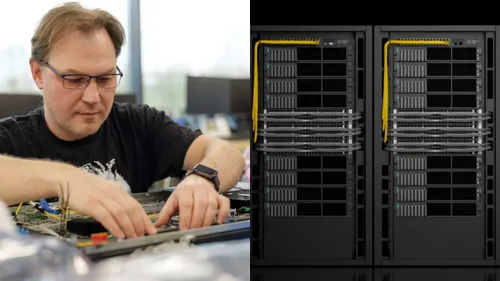


Traysar, an Austin-based company that describes itself as a subterranean defence technology firm, is partnering with the edge computing company Armada to install AI data centres below ground. The pairing, announced on 1 October, combines Traysar's Terminus boring platform with Armada's modular data centre units, and is aimed at US government and military customers that need computing capacity to survive attack.
Terminus is a truck-mounted boring rig that Traysar launched in September at a sovereign AI event in Washington, DC. The pitch is physical protection: putting critical systems under the surface rather than relying on fences, walls and distance.
"Terminus transforms the Earth's crust into a protective layer for the systems America depends on most," said Yadin Soffer, Traysar's co-founder and chief executive. Dan Wright, who leads Armada, said "the future of AI infrastructure is distributed, sovereign, and resilient."
What The Companies Have Not Said
The announcement is thin on the details that would let an engineer assess it. Neither company has given depths, tunnel dimensions, how long a deployment takes, how much power an underground unit can draw, or how heat is removed from a sealed space underground.
Cooling is the obvious question. Data centres reject large amounts of heat, and a surface facility does it with air or water moving freely through the site. Underground, that heat has to go somewhere, and the rock around a tunnel absorbs only so much before the surrounding ground warms up and the method stops working.
Power and connectivity raise similar questions. A buried facility still needs electricity and fibre coming in from somewhere, and those entry points are as exposed as any surface building.
Who This Is Actually For
The target market explains the trade-offs. Defence customers in contested environments weigh survivability above efficiency, and a facility that costs more to cool but keeps running under attack is a reasonable purchase for a military that assumes its fixed sites will be found and struck.
Armada has form here, having supported US Navy edge computing during the UNITAS exercises, and it builds units that can run air-gapped where required. Traysar is backed by Silent Ventures, Lux Capital and Craft.
The same economics do not transfer to commercial operators. A company choosing where to put AI capacity optimises for cost per megawatt and speed to power, not resistance to precision strikes.
Armada Is Building A Larger Position
The underground project is one piece of a company that has raised serious money. Armada closed a $230 million Series B in May, led by Overmatch, BlackRock and 8090 Industries, taking total funding to nearly $500 million, and its investor list runs from Johnson Controls and Mitsui to Founders Fund and Singtel Innov8.
Its product range covers Galleon modular pods, megawatt-scale Leviathan units and smaller Beacons designed for oil rigs, and it has deployed with customers including Aramco, Aker BP, TampNet, the US Navy and Alaska's transport department. With Johnson Controls it is building a 400,000 square foot manufacturing plant.
On the same day as the Traysar announcement, Palantir named Armada as a partner for sovereign AI infrastructure, combining Palantir's software with Armada's hardware so customers can run and fine-tune open-weight models on equipment they own.
"Sovereignty is not something you rent," said Palantir chief executive Alex Karp. "It is owning the weights, the data, and the hardware those models run on, and knowing where that hardware was built."
Sovereign AI Has Become A Product Category
Two years ago, sovereign AI mostly meant a government asking where its data was stored. It now describes a market with hardware, software and deployment services attached, built on the premise that some organisations will not run their workloads on another country's cloud.
That demand is real and growing, driven by export controls, by governments uneasy about dependence on US hyperscalers, and by militaries that want computing capacity they control outright. The underground proposition is the most extreme version of the idea: not just owning the hardware, but putting it where it cannot easily be reached.
What It Signals For Everyone Else
For commercial buyers, the useful signal is how far the market has moved from the assumption that compute belongs in large shared facilities. Capacity is being pushed to ships, oil rigs, remote sites and now tunnels, because latency, connectivity and control matter in places a hyperscale region cannot serve.
The same logic drives industrial edge deployments, where processing sits beside the machines it serves, a shift we traced in how physical AI turns IoT sensing into action. Defence requirements usually arrive first and the engineering filters outward later.
A Claim That Needs Proving
Burying data centres is an old idea in new clothing, since military and government facilities have been put underground for decades, and a handful of operators have used disused mines for commercial hosting. What is new is the attempt to make deployment fast and repeatable with a boring rig on a truck.
Whether that works is unproven. Until Traysar and Armada show a completed installation with figures for depth, power, cooling and build time, this is a partnership announcement rather than a demonstrated capability. The defence customers it targets will ask for exactly those numbers before they buy.