
Solvely.ai, a San Francisco, California startup that makes an AI study app for students, has set out how it wants its software to behave: as a tutor that walks a learner through a problem, not a machine that hands over the answer. The company published its position on 10 October, built around comments its co-founder made at an education investment event in September.
Richard Weiqi Zhang, who co-founded Solvely, made the case on 18 September at Funding Conviction, an online panel on education investment run by the newsletter Edtech Insiders. He shared the virtual stage with Steve Kupfer of the venture firm Reach Capital and Ben Nelson, founder of Minerva, the university known for its online-first teaching model.
“Learning has to make the person more capable,” Zhang said. “The goal is still to empower the learner, not to replace them.”
How The App Teaches
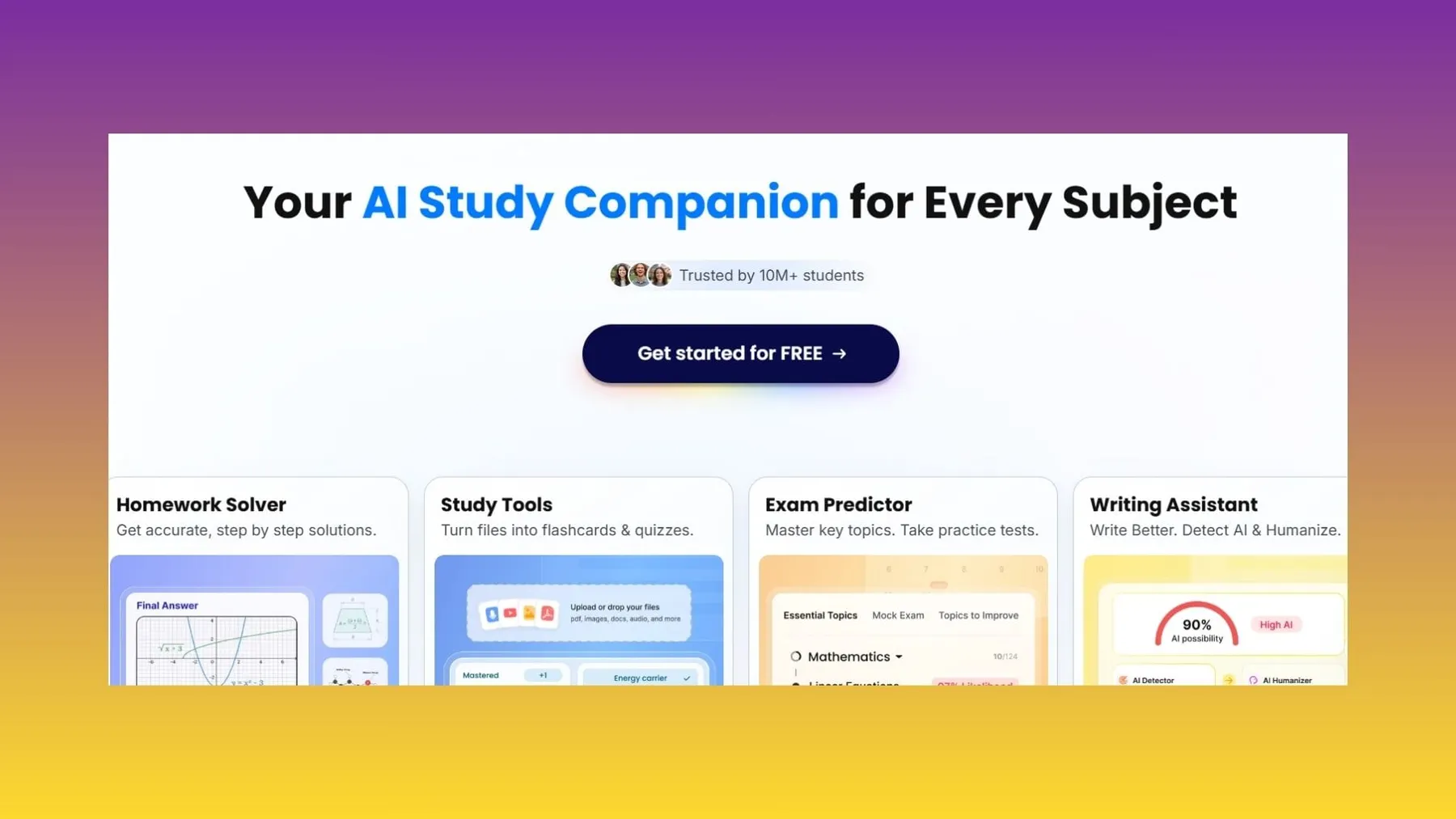
Solvely says it trains its own versions of AI models on education material, a step the industry calls post-training, so that a general-purpose model gets better at specific study tasks. When a student uploads a photo or a document, the system finds the questions on the page, separates them one by one and sends each to the solving method and drawing tools that suit it. For problem-solving, the company says it checks an answer across more than one AI model before showing it.
A student working through a maths question can follow the solution line by line, ask a follow-up when a step makes no sense and watch the problem explained on an on-screen whiteboard. Before an exam, the same app turns the student’s own course notes into study guides, flashcards and quizzes.
Anthropic, the company behind the Claude family of AI models, has published a customer story on Solvely that shows the startup using Claude to build interactive charts inside its lessons. A student studying economics, for example, can change the numbers and watch a supply and demand curve shift on screen instead of reading a fixed diagram in a textbook. Microsoft and Meta, by contrast, have been swapping Claude for their own tools inside their companies.
Dr Nick Yuan, Solvely’s co-founder and AI lead, told Anthropic that the tone of the model matters for tutoring subjects such as history and social science, where a student needs a concept explained the way a person would explain it. “Claude feels very personalized,” he said.
Standing Out Among Answer Apps
Zhang’s argument lands in a market where many apps compete on the opposite promise. A search of the browser extension stores for homework help turns up listings that offer instant answers to online quizzes, often pitched as fast and discreet, with a screenshot of the question as the only input. Solvely sells to the same students, through an app that photographs a question and returns a solution, so the difference it claims sits in what happens after the photo is taken.
Its app store listing, published under the developer name Aignite Inc., describes step-by-step explanations alongside lecture notes, a reader and a calculator, with an unlimited plan priced at $12.99 a month in the US store. Solvely launched in San Francisco in 2023 and now says it has served more than 15M users in over 180 countries. That is well above the 5M students cited on its app store page and in the earlier Anthropic case study, and the release does not explain the gap.
Investors and industry groups have started to list the startup among AI names to watch. Nasdaq and the venture firm Notable Capital placed it on their first Prosumer AI 40, a list of AI products used by individuals at work and at home, which also includes OpenAI, Anthropic, Cursor and Lovable. The ASU+GSV Summit, a large education technology conference, picked Solvely for its 2026 GSV Cup 50 of promising education startups.
Solvely also sells an AI detector, a tool that estimates whether a piece of writing came from an AI system, and its wording on this product is the most careful in the announcement. The company says the tool gives signals that a teacher or student can look at more closely, and that it does not prove who wrote a text. Users, it says, stay responsible for checking the output and following their school’s rules.
Solvely has also published research on how it builds the detector, covering how it develops, fine-tunes and tests the specialised models behind it. Framing the score as a prompt for a closer look keeps the final call with a person, much as Google now asks publishers to check AI drafts by hand before relying on them.
Teaching As The Selling Point
Solvely has not announced a new product or a funding round alongside the statement, and it has published no outside measure of whether its users learn more than students who use answer-only tools. What it has put on record is a description of intent, tied to features already in its app: the step-by-step working, the follow-up questions, the charts students can change and the detector that leaves the final judgement to a person.
The statement shows a young company choosing to describe its AI by what students can do after using it, at a time when much of the homework-help market still sells on speed. Zhang made that case to an audience of education investors, and Solvely’s place on lists alongside OpenAI and Anthropic shows that audience is paying attention, while the evidence on learning has yet to be published.