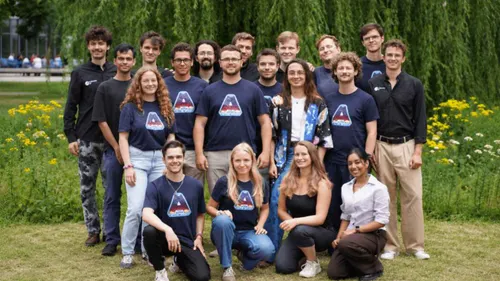


German space startup Marble Imaging has secured €6M to build a fleet of satellites that take very detailed pictures of the Earth. Berlin-based venture capital firm Cherry Ventures led the round.
The money extends a €5.3M seed round that the company announced in December 2025. Government-backed investor High-Tech Gründerfonds led that earlier round, which brings the two rounds to €11.3M. The startup, based in Bremen, Germany, was founded in August 2023.
The company plans to launch its first satellite, Marble Sat-1, in early 2027 and grow the fleet to 30 by 2030. The imagery, along with AI analysis of it, will be sold to defence, civil security and critical infrastructure customers.
Sharper Images From Orbit
The company says Marble Sat-1 is fully funded and has completed its pre-flight testing. The satellite will capture images at up to 0.7 metres resolution, meaning each pixel covers a patch of ground 70 centimetres across.
The camera captures visible light and near-infrared. Near-infrared lies just beyond human sight and is widely used to study vegetation. The satellite will also collect short-wave infrared data, a band that helps tell materials apart and see through haze.
Marble aims to photograph the same location up to once an hour when the full constellation is in orbit. Its AI platform merges the pictures with other data sources. Existing services include spotting objects, assessing whether vehicles can cross terrain, monitoring coastal assets and mapping land cover.
Outside partners help build the hardware. Scanway, a space company in Wrocław, Poland, is developing the telescopes. Reflex Aerospace of Munich, Germany, is building the platform, the main body that carries the camera, for the first satellite.
A Push For European Coverage
Marble argues that Europe and its partners depend on providers outside the continent for very-high-resolution imagery. The company says this dependence could cost them coverage over regions such as Ukraine or the Strait of Hormuz.
“To make better decisions, data access must be immediate and actionable,” said Robert Hook, Marble’s co-founder and chief executive. “Europe and many of its global partners lack this capability today. We at Marble are determined to close this gap.”
Filip Dames, founding partner at Cherry Ventures, said: “Europe needs its own eyes in space, and Marble Imaging is building them.”
The funding comes as Germany plans to spend more on space for defence. In September 2025, Defence Minister Boris Pistorius announced plans to invest €35bn in space-related defence projects by 2030, describing satellite networks as “an Achilles heel of modern societies”.
Early Backing And A Later Launch
Separately from its equity rounds, Marble has secured more than €10M in non-dilutive funding for its first satellite. Non-dilutive funding does not require giving up shares. The money came from a small-satellite payload competition run by the German Aerospace Center (DLR) and from the European Space Agency’s (ESA) InCubed programme for commercial Earth observation.
ESA is also the company’s first anchor customer, meaning its first large committed buyer. The €3M contract sits within the Copernicus Contributing Missions programme. Through the programme, ESA buys data from commercial satellites to supplement the European Union’s own Copernicus Earth-observation fleet.
In December 2025, Marble planned to launch its first satellite in the fourth quarter of 2026 and reach up to 20 satellites by the end of 2028. The company has since moved the first launch to early 2027 and set a target of 30 satellites by 2030.
Hook runs the company with co-founders Gopika Suresh, the chief technology officer, and Alexander Epp, the chief commercial officer. Raul Scarlat, also part of the founding team, serves as lead instrument scientist.
The extension adds fresh capital to a company whose first satellite is already paid for and tested. The work now moves to getting Marble Sat-1 into orbit and growing one spacecraft into the fleet the company says European defence and security users need.