

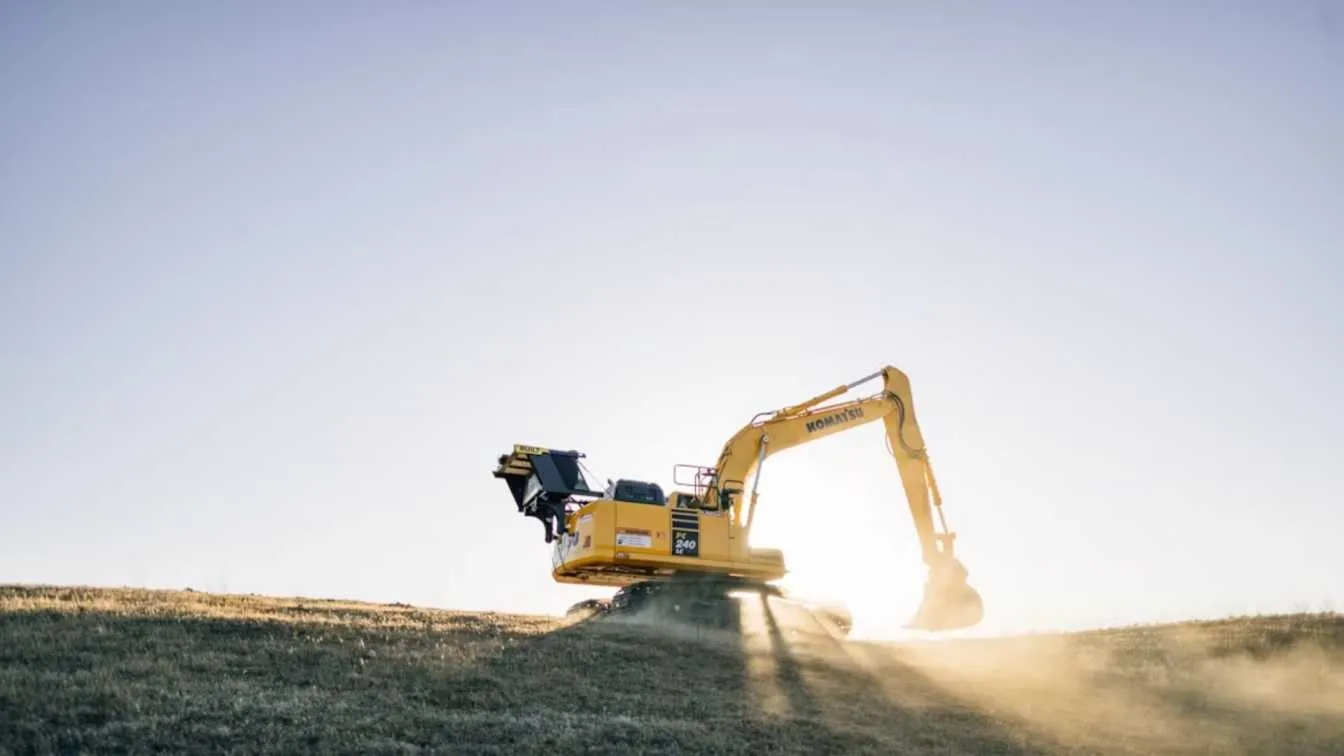
A mining truck, an excavator on a pipeline route or a combine harvester in a remote field is an expensive machine doing expensive work. When it breaks down, every hour of downtime costs money. When it needs a service, the manufacturer and dealer want to know before the customer calls. That is why heavy equipment makers have spent the past two decades fitting their machines with telematics: units that report location, engine hours, fuel use, fault codes and operating data.
The difficulty is that heavy equipment often works where networks do not. Mines, quarries, forests, oil fields, farms and large construction projects frequently sit outside reliable cellular coverage, and machines move between sites with very different connectivity.
On 28 July 2026, Iridium and SKYWAVE, an ORBCOMM company, announced a partnership aimed at that problem. Iridium’s Short Burst Data service will be embedded directly into SKYWAVE’s satellite IoT terminals, which already manage connections across satellite, cellular and Wi-Fi. The initial target is heavy equipment manufacturers.
It is a less dramatic announcement than this year’s multi-billion-dollar satellite deals. It is also a clear example of how satellite IoT is actually being used today: not as a replacement for cellular, but as one path in a hybrid design.
What The Partnership Covers
The details come from the companies’ joint announcement.
Iridium Inside SKYWAVE Terminals
Iridium’s Short Burst Data service, known as SBD, will be built into SKYWAVE satellite IoT terminals. The terminals will combine Iridium’s low Earth orbit satellite network with SKYWAVE’s multi-network management software and its OGx IoT platform, as well as cellular and Wi-Fi connections.
The result is a device that can choose the most suitable network for each situation: cellular where it is available and affordable, Wi-Fi at depots or sites with local networks, and satellite where nothing else reaches.
What It Is For
The partners list remote monitoring, diagnostics and predictive maintenance, service support and the modernisation of connected fleets as the main applications. The focus is heavy equipment manufacturers first, with the architecture designed to extend to other industries that operate globally or beyond terrestrial networks.
Status
IoT Business News reported that the integration is under way. The announcement did not name equipment manufacturers as customers, give a date for commercial availability or disclose pricing.
Who SKYWAVE Is
The SKYWAVE name has a long history in satellite IoT, and the current brand reflects a recent reorganisation.
From ORBCOMM To SKYWAVE
ORBCOMM, a US satellite IoT company, has operated its own low Earth orbit satellites and resold capacity on other networks for decades. It acquired SkyWave Mobile Communications, a Canadian satellite IoT specialist, in 2015. ORBCOMM has since brought its industrial IoT enablement business under the SKYWAVE name. The company’s website describes it as the rebranded platform from ORBCOMM, with “same technology,” focused on hybrid satellite-cellular connectivity.
Scale And Reach
SKYWAVE says it connects more than 900,000 critical assets and works with more than 500 partners in over 90 countries through its SKYWAVE Connect ecosystem. It serves transportation, agriculture, oil and gas, and maritime customers.
According to Berg Insight’s satellite IoT market report summary, ORBCOMM had about 742,000 satellite IoT subscribers across its own network and the Viasat network, making it the second-largest satellite IoT provider after Iridium.
A Hybrid Product Line
In January 2026, SKYWAVE launched the ST 4000, an embeddable module that combines satellite and cellular capabilities in one device. Dave Roscoe, SKYWAVE’s president, said it “was built to unify satellite and cellular capabilities into a single device.” The company’s product range also includes programmable terminals, rugged satellite modems and solar-powered trackers.
The Iridium partnership fits that direction: more network options inside the same hardware family.
What Iridium Brings
Iridium operates 66 active satellites in low Earth orbit and covers the entire planet, including the oceans and polar regions. Berg Insight counted it as the largest satellite IoT operator, with about 2.0 million subscribers.
Short Burst Data
SBD is Iridium’s long-established service for small messages. Devices send and receive short packets, typically a few hundred bytes, over Iridium’s network. It suits exactly the kind of data heavy equipment generates: IoT Business News described it as appropriate for “status updates, alerts, operating parameters and other compact telemetry payloads.”
Because Iridium’s satellites are in low orbit, the delay between a machine sending a message and the message arriving is short compared with geostationary systems, and the coverage is truly global.
The Pitch
Matt Desch, Iridium’s chief executive, leaned on that coverage: “For more than two decades, Iridium has provided the only pole-to-pole mobile satellite network, delivering the coverage, resiliency, and reliability that mission-critical operations demand.”
Proprietary Now, Standards Later
SBD is a proprietary Iridium service, requiring Iridium-specific hardware. Iridium is separately launching NTN Direct, a standards-based NB-IoT service that ordinary cellular modules can use, with commercial availability for Deutsche Telekom IoT customers from the fourth quarter of 2026. The SKYWAVE partnership relies on the proven service rather than the new one, which makes sense for equipment makers who need reliability today.
Why Heavy Equipment Needs Hybrid Connectivity
Heavy equipment is one of the clearest cases for combining networks.
Machines Move Between Worlds
An excavator may spend one month on an urban construction site with strong 4G coverage and the next on a rural road project with none. A mining haul truck may work in an open pit with a private network but travel on access roads without coverage. A tractor may be connected at the farmyard and invisible in the far fields. A connectivity design based on a single network will fail somewhere.
We looked at how industrial sites approach these trade-offs in our explainer on industrial IoT and industrial connectivity.
Cost Management
Satellite data costs more than cellular. A hybrid device can send large or routine data over cellular or Wi-Fi when available, and reserve satellite for essential messages such as alarms, location updates and fault codes when nothing else is in range. Managing that choice automatically, rather than leaving it to device firmware written by each manufacturer, is part of what SKYWAVE sells.
Long Service Lives
Heavy equipment is used for many years, often a decade or more, and frequently resold into different regions. Connectivity chosen when a machine is built needs to keep working through network changes and across borders. A multi-network approach reduces dependence on any single operator or technology, including cellular networks that may be retired during a machine’s life.
Where The Value Lies For Manufacturers
For equipment manufacturers, telematics has become a business in its own right.
Service And Uptime
Remote diagnostics let dealers identify faults before a technician visits, bring the right parts and reduce repeat trips. Predictive maintenance uses operating data to schedule servicing before failures happen. For customers running expensive machines on tight schedules, uptime is often more valuable than the machine’s purchase price. We explored how machine data feeds operational decisions in our story on turning machine data into manufacturing decisions.
Modernising Older Fleets
Sameer Agrawal, ORBCOMM’s chief executive, pointed to this: “Heavy equipment OEMs are looking for ways to modernize legacy deployments, expand connected service capabilities and deliver reliable digital experiences wherever their equipment operates.”
Many machines in the field carry older telematics units, some relying on cellular networks that are being switched off. Retrofitting them with hybrid terminals is one route to keep them connected.
A Networking Layer
Agrawal also described the partnership as “an important step in SKYWAVE’s mission to become the intelligent networking layer for industrial IoT,” according to IoT For All. That ambition matters. SKYWAVE is positioning itself not as a single-network provider but as the layer that manages several networks on behalf of manufacturers.
How It Fits The Wider Market
The partnership reflects several trends in satellite IoT.
Satellite As A Component
IoT Business News characterised the architecture as positioning satellite “not as a niche alternative to cellular, but as a component of hybrid connectivity designs.” That is the pattern emerging across the industry. Omdia’s forecast that satellite IoT connections will reach 197.6 million by 2035 frames satellite as a complement to terrestrial networks, not a replacement.
Proprietary And Standards-Based Paths
Two routes to satellite IoT are developing side by side. Proprietary services like Iridium SBD and SKYWAVE’s own satellite offerings are proven, widely deployed and supported by rugged hardware. Standards-based services, built on 3GPP non-terrestrial network specifications, promise to let ordinary cellular modules reach satellites. For industrial customers who need reliability now, proprietary services remain the default. Over time, the two may converge in multi-network devices.
Consolidation Around Iridium
Iridium itself is changing hands. In June 2026, Rocket Lab agreed to acquire Iridium in a deal valued at around $8 billion, expected to close in 2027. Partnerships with established IoT integrators such as SKYWAVE add to the value of Iridium’s IoT business, which has become a significant part of its growth.
Beyond Heavy Equipment
The partners describe heavy equipment as a starting point. The same design applies to other industries where assets are valuable, mobile and often out of range.
Energy And Utilities
Oil and gas operators run wellheads, pumps, tanks and pipelines across remote regions, often far from cellular coverage. Utilities manage substations, water systems and renewable energy sites in similar conditions. For these assets, a hybrid terminal can report routine readings over whatever network is available and send alarms over satellite when nothing else is in range.
Agriculture And Transport
Farm machinery, irrigation systems and livestock operations cover large areas with patchy coverage. Trucks, trailers and rail assets cross regions where networks come and go. SKYWAVE already lists transportation, agriculture, oil and gas, and maritime as core markets, and the Iridium link extends its options in each. We looked at how trackers keep assets visible in difficult places in our story on tracking assets that have no power.
What Remains To Be Seen
Several details will determine how much the partnership matters in practice.
The first is customers. No manufacturers were named. Large equipment makers typically run their own telematics programmes and supplier relationships, and winning them takes time.
The second is timing. The integration is under way, but availability dates have not been announced.
The third is cost. Satellite data remains more expensive than cellular, and manufacturers will weigh the added cost against the value of complete coverage.
The fourth is integration with existing telematics standards. Many construction equipment owners run mixed fleets from several manufacturers and expect data to flow into common fleet management systems. How hybrid connectivity fits into those workflows will matter to end customers.
What Buyers Should Ask
For equipment manufacturers and fleet owners considering hybrid connectivity, a few questions are useful.
Where do machines actually operate, and how much of their working time is outside cellular coverage? That determines how much satellite capacity is needed.
What data must be sent from beyond coverage, and how urgently? Alarms and location may justify satellite; bulk operating data can often wait for cellular or Wi-Fi.
How does the device decide which network to use, and can those rules be configured? Automatic network selection is valuable only if it matches the operator’s priorities and budget.
How will the hardware handle network changes over a machine’s life, including cellular retirements and new satellite services?
What does the full cost look like, including hardware, subscriptions and data across all networks?
Satellite As A Quiet Backstop
The Iridium and SKYWAVE partnership will not change the satellite industry. What it shows is how satellite IoT is being used by companies that depend on it every day. For heavy equipment, the goal is simple: every machine reporting reliably, wherever it works, at a cost that makes sense.
That usually means cellular most of the time and satellite when needed, managed by a device smart enough to know the difference. As direct-to-device services and standards-based satellite connectivity mature, those hybrid devices are likely to gain more options. For now, a proven low orbit network inside an established industrial terminal is a practical step for machines that cannot afford to go silent.