
Gallium Defense has revealed €7.1M in seed funding and a radar that the company says can spot small drones up to 10 km away. Keen Venture Partners and 360 Capital co-led the round in June, with Omnes Capital and Polytechnique Ventures also investing. The money will pay for the first production radars, AI model training, a larger team and demonstrations for civil and military customers.
All three founders passed through Boston Consulting Group (BCG) before setting up the company in April. Chief executive Eric Fournier spent 17 years in consulting at Roland Berger and BCG, with a focus on aerospace and defence. Chief operating officer Robin Mandel worked as an engineer at aerospace group Safran and later as an operations director at defence group Thales.
Chief technology officer Florian Lemoine spent eight years at France's defence procurement agency, the Direction générale de l'armement (DGA), and then became a senior adviser at the North Atlantic Treaty Organization (NATO). Fournier wants Gallium to become "the Dacia of the radar", a nod to the low-cost car brand owned by Renault, and said the company is built around one question: "how do you meet 80% of the need at 20% of the price?"
The GDS-10 Radar
Gallium’s first product, the GDS-10, is an X-band radar, meaning it runs on microwave frequencies often used in short-range drone detection. The radar steers its beam electronically rather than by turning its antenna, a design known as an active electronically scanned array, and runs AI on built-in graphics chips to process what it picks up. Gallium says the design relies on cheaper antenna components and off-the-shelf parts wherever possible to keep the price down. Work on the radar began in 2024 with radar design specialists from the part of France known as Microwave Valley.
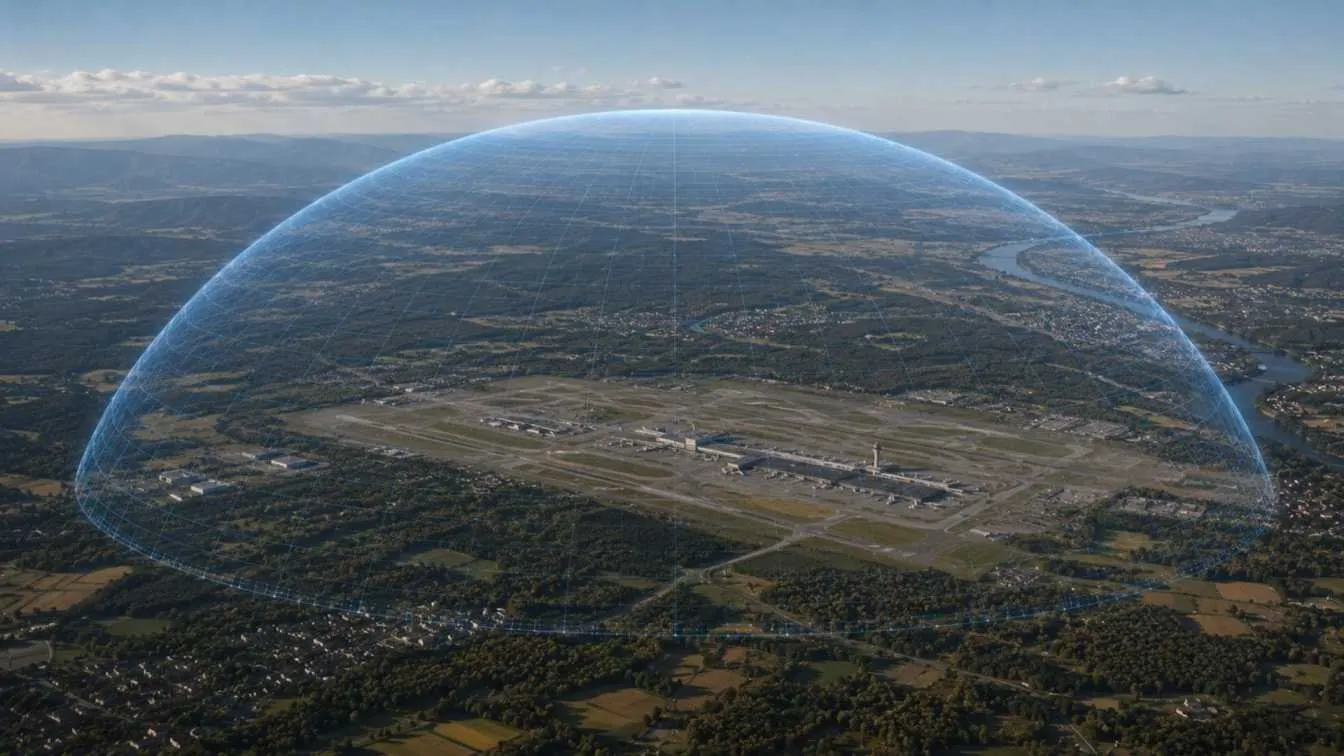
Gallium says the radar sees a full circle around itself and up to 90 degrees overhead. The GDS-10 can track several targets at once, including swarms of drones flying together, and keeps working day and night, in bad weather and under electronic jamming, according to the company. The radar is built to catch Class 1 drones, the lightest category under NATO rules, as well as first-person-view (FPV) drones flown by pilots watching a live camera feed.
The GDS-10 is aimed at airports, ports, energy sites and other critical infrastructure, while a second version, the GDS-10-M, is set up for armed forces. The radar can be mounted on a mast, roof, trailer or vehicle. The company’s website lists open interfaces including SAPIENT, a counter-drone data standard used by NATO, and ASTERIX, the air-surveillance data format maintained by European air traffic body Eurocontrol.
Customers, Investors And Rivals
Gallium has no revenue yet but is in talks with six potential customers and aims to book about €6M in orders in 2027. The company plans monthly outdoor demonstrations in the meantime and hopes to expand from France into Germany and Eastern Europe.
Amsterdam-based Keen Venture Partners closed more than €150M for a European defence and security fund in 2025.
“Great defence starts with superior visibility,” said Alexander Ribbink, a partner at Keen and formerly chief operating officer of navigation company TomTom. Alexandre Mordacq, a partner at 360 Capital, said: “Drones have turned air security and air defense into a need for thousands of sites.”
Gallium will compete with established radar makers. Dutch company Robin Radar signed a contract with the Netherlands’ Ministry of Defence in December 2025 to supply 100 of its IRIS radars, and Swedish defence group Saab and Kraken Technology Group have fitted a drone-detection radar to an uncrewed boat. In Europe, reported drone sightings led Munich Airport to halt flights twice in October 2025.
Gallium is competing on price, using cheaper parts to build a radar for airports, ports, energy sites and armed forces. Its founders bring long careers in defence and consulting to the effort, and the company aims to have its first units with customers next year.